How to Select a Laser Rangefinder Module for Handheld Optics
A handheld optic has almost no spare room. The battery, display, eyepiece, processor, housing, seals, buttons, and optical channels are already competing for space. Add ranging hardware and the product can become bigger, heavier, or badly balanced very quickly.
That’s why choosing a laser rangefinder module for handheld optics should begin with the handheld product around it, not with the largest distance number on a datasheet.
A compact binocular used for field observation has different needs from a larger thermal viewer or a tripod-capable observation device. The right module has to fit the available envelope, stay within the battery budget, work with the actual target, and send distance data cleanly to the host electronics.
What a Laser Rangefinder Module for Handheld Optics Needs to Get Right
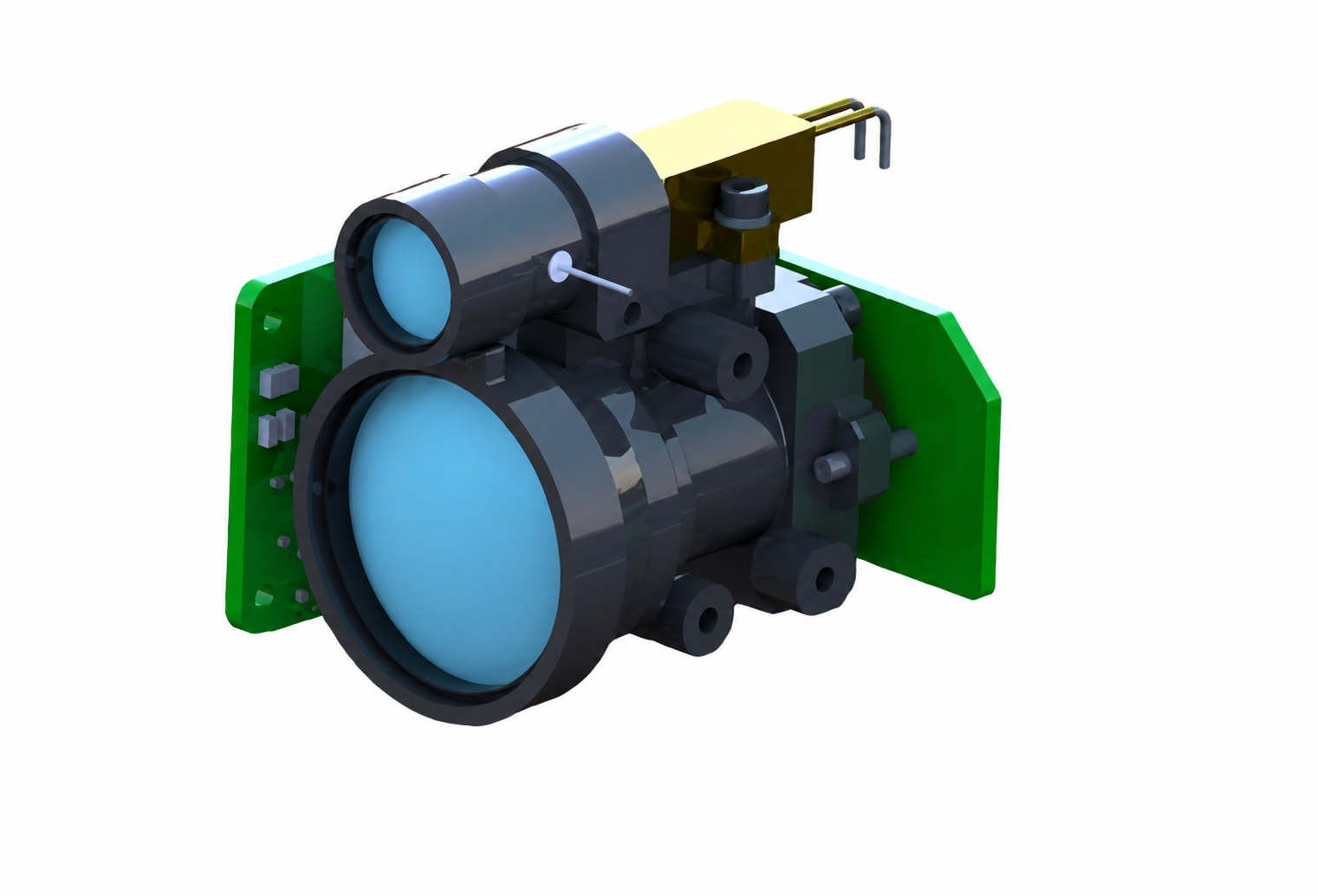
Handheld equipment punishes excess.
A few extra millimeters can interfere with a battery tray. Twenty grams in the wrong place can make binoculars feel nose-heavy. A high peak current can force you into a larger battery. Even a connector facing the wrong direction can turn a neat internal layout into a wiring headache.
Range matters, but it belongs beside:
physical size;
weight;
input voltage;
power draw;
beam divergence;
serial interface;
optical-window transmission;
laser-to-viewing-axis alignment.
Before choosing a unit, ask a few practical questions. What will the user measure? How far away is it most of the time? How much space is actually free inside the housing? What is the mass limit? What voltage is already available? Where will the cable go?
Those answers usually narrow the choices faster than chasing a bigger kilometer figure.
Start with the Target Before Choosing the Distance Class
“I need 5 km” sounds like a clear requirement. In practice, it leaves out much of what determines usable ranging distance.
A large pale wall can return much more laser energy than a small dark object. Haze, rain, dust, glass, steep target angles, and low-reflectivity surfaces can all reduce usable reach. Hand movement matters too. The laser still has to hit the object the user thinks they are aiming at.
Write down the normal target first:
target type;
approximate width and height;
surface;
normal working distance;
farthest useful distance;
typical visibility.
That short list tells the supplier far more than a distance number by itself.
Why Target Size and Surface Change Ranging Distance
At long distance, the laser footprint is no longer a tiny dot.
The beam spreads as it travels. Once the footprint becomes larger than the target, part of the emitted energy goes past the object instead of hitting it.
Surface behavior matters just as much. Concrete, vegetation, rock, dark paint, glass, vehicle bodywork, and water do not return laser energy in the same way.
A binocular mainly used on buildings, large terrain features, and vehicles has a much easier ranging task than one expected to measure a small dark object at the same distance.
This is one reason published maximum range should never be read without the target conditions beside it. Huanxin’s 3K-193, for instance, specifies its ≥3 km rating together with visibility, humidity, turbulence, target reflectivity, and target size conditions.
Compact Laser Rangefinder for Binoculars: Start with Space and Weight
A compact laser rangefinder for binoculars has to disappear inside an enclosure that was never generous to begin with.
The rangefinder may sit beside the viewing channels, under the center bridge, close to the battery, or behind a shared front window. Shape matters almost as much as total volume.
Huanxin's 3K-193 measures 48.5 × 36 × 26 mm and weighs no more than 60 g. The 4K-254 measures no more than 55 × 34 × 45 mm and weighs no more than 75 g.
Fifteen grams may not sound like much on a specification sheet. Put that weight toward the front of a binocular and the difference becomes easier to feel.
The same applies to dimensions. A few extra millimeters may affect grip width, internal ribs, battery position, screw locations, or where the optical channels can sit.
When a Compact Laser Rangefinder for Binoculars Makes Sense
A 3 km or 4 km unit is often a sensible starting point when the main targets are buildings, vehicles, terrain, tree lines, or other reasonably large objects within a few kilometers.
That doesn't mean every handheld product should stop at 4 km.
The real question is whether the extra reach earns its place inside the housing. Longer-distance hardware may ask for more volume, more energy, or different optical packaging.
If the typical user works at 500 m to 2 km, putting a much larger long-range unit inside every device may simply make the finished product heavier and more expensive without improving everyday use.
How to Fit a Laser Rangefinder Module for Handheld Optics into the Housing
Don't check only length, width, and height.
You also need room for the connector, cable bend, mounting screws, optical aperture, and any alignment adjustment required during assembly.
Pay attention to cable direction. A unit may technically fit inside the available cavity while forcing the cable directly into the battery or outer housing.
Service access deserves some thought too. If technicians can reach the connector only after removing several unrelated components, production becomes slower and repairs become more frustrating.
A Few Millimeters Can Change the Whole Enclosure
Compact optics have a domino effect.
Move the rangefinder by 3 mm and the battery may have to move. Shift the battery and the grip may become wider. Move the grip and suddenly the exterior tooling changes.
This is why the mechanical drawing should be checked early.
Quick Check: 3 km or 4 km for a Handheld Product?
The current Huanxin 3K-193 and 4K-254 specifications illustrate the trade fairly well.
The 4 km unit gives you more reach. The 3 km unit gives you a smaller, lighter package and a straightforward 5 V supply.
Neither is automatically the better choice.
The handheld product decides which trade is worth making.
OEM Rangefinder for Handheld Optics: Match It to the Battery
An OEM rangefinder for handheld optics rarely has a battery to itself.
A digital binocular may already be powering image sensors, a display, processor, storage, wireless electronics, and illumination. A thermal viewer can have an equally tight power budget.
Check more than nominal voltage.
Look at standby consumption, normal operating draw, peak demand, cable loss, cold-weather battery behavior, and the repetition rate the user is likely to select.
The 3K-193 uses 5 V DC. Huanxin lists the 4K-254 at 9–15 V DC, with standby power of ≤1.5 W, rated power of ≤3.5 W, and peak power of ≤7 W.
Why care about the peak if it lasts only briefly?
Because a small battery can look perfectly adequate from its average power figure and still suffer voltage drop during short current peaks. Small cells, thin wiring, cold temperatures, and tight protection circuits can make that worse.
OEM Rangefinder for Handheld Optics: TTL or RS-422?
TTL often makes sense when the rangefinder sits close to the main processor and the cable is short.
RS-422 can be attractive when the wiring is longer, passes near switching electronics, or needs stronger resistance to electrical noise.
The interface name isn't the only thing to check. Confirm:
logic level;
baud rate;
command format;
returned distance format;
error messages;
startup behavior;
single-ranging commands;
repeated-ranging commands.
Settle these items while the electronics and housing are still flexible.
Keep the Serial Link Easy to Reach
If the communication connector is also used during factory setup or firmware work, technicians should be able to reach it without dismantling half the optic.
Keep the cable away from sharp housing edges and components that become warm during operation.
Small details like these don't attract attention in a brochure, but they make a big difference on an assembly line.
Beam Divergence Changes What the User Can Hit
Beam divergence tells you how quickly the laser footprint grows with distance.
Using simple geometry, a 0.5 mrad beam corresponds to roughly 0.5 m at 1 km and about 1.5 m at 3 km. A 0.3 mrad beam produces a smaller footprint at the same distance.
So should you always choose the narrowest beam available?
Not necessarily.
A handheld optic moves. If the viewing axis and laser axis are slightly offset, a very narrow beam may miss a small target even though the reticle appears centered on it.
The useful beam width depends on target size, distance, pointing stability, and how accurately the laser can be aligned with the viewing channel.
Boresight Error Becomes More Noticeable with Distance
Imagine the reticle sitting on a road sign while the laser axis points slightly to the right.
At a short distance, the beam may still hit the sign. Several kilometers away, the same angular offset can place the beam outside it.
This makes mounting accuracy especially important in binoculars and monoculars where the user expects the distance reading to belong to whatever sits under the reticle.
The mount also needs to keep that relationship as temperature changes.
Treat the Optical Window as Part of the Laser Path
A protective front window may look like a housing component, but the laser sees it as part of the optical path.
The outgoing pulse passes through the window. The returned signal often passes through it again.
Material, coating, thickness, tilt, clear aperture, and spacing can all affect what happens next.
A window selected mainly for visible-light transmission isn't automatically the right choice for 1535 nm. Internal reflections may also send unwanted light toward the receiver.
If the laser and camera share the same front window, provide the window information before the enclosure geometry is locked.
Keep the Transmit and Receive Apertures Clear
Gaskets, retaining rings, adhesive, paint, and housing ribs can enter the optical path.
Even a small obstruction close to an aperture may reduce outgoing energy or returned light.
Reflective internal surfaces near the transmitter and receiver should also be treated carefully, particularly inside a tightly packed binocular housing.
Window Loss Works in Both Directions
Think of it as a round trip.
The outgoing pulse can lose energy before it reaches the target. The returning signal can lose more before reaching the receiver.
A poor front window can make a capable ranging module look much weaker after it has been installed.
Why 1535 nm Works Well in Many Professional Handheld Optics
Huanxin's current product family is built around 1535 nm laser ranging and covers distance classes from 3 km to 20 km, including compact options intended for handheld optics and other electro-optical equipment.
For an OEM buyer, wavelength shouldn't be treated as an isolated specification.
The front window, coatings, transmitter, receiver, beam path, and laser classification of the finished product all need to work together.
The selected module's stated laser classification and operating conditions should also be checked against the finished handheld product and the requirements of its destination market.
Choose the Repetition Rate Around Real User Behavior
One distance reading after a button press is very different from repeated ranging while someone follows a moving object.
Huanxin's compact 3 km and 4 km units both list adjustable operation from 1 to 10 Hz.
That gives the handheld device room to offer a single reading, slower repeated updates, or faster refresh where the application needs it.
Faster refresh can make the display feel more responsive. It also changes energy use and heat inside a small enclosure.
Don't choose the default rate because 10 Hz sounds better than 1 Hz. Choose it around what the user will actually do with the product.
When 3 km or 4 km Is Not Enough
Some handheld optics genuinely need more reach.
Large observation binoculars, tripod-capable viewers, coastal observation equipment, or specialized long-distance optics may have enough internal volume and battery capacity for 6 km, 8 km, or more.
Huanxin currently lists 3 km, 4 km, 6 km, 8 km, 12 km, 18 km, and 20 km classes. The 6K-256 uses 9–15 V and adjustable operation up to 10 Hz, while the 8K-338 uses 4.5–15 V and lists a beam divergence of 0.3 mrad.
A handheld device doesn't become better simply because its brochure shows a larger range figure.
Move to a longer-distance unit when the target, working distance, and available space actually call for it.
What to Send Before Asking for a Custom Configuration
You don't need to send a twenty-page document to begin an OEM conversation.
You do need to provide useful numbers.
Huanxin Measurement & Control Technology Co., Ltd. manufactures 1535 nm laser rangefinder modules and offers customization covering communication interfaces, input voltage, connectors, mechanical dimensions, mounting arrangements, and selected performance parameters for OEM integration.
Sharing the information in the table above gives the engineering team a much clearer picture of what needs to fit inside your handheld product.
A Better Handheld Product Starts with the Right Module
The best laser rangefinder module for handheld optics isn't automatically the smallest unit or the one with the longest reach. It's the one that fits the enclosure without forcing awkward changes, reaches the targets users actually care about, works with the available battery, communicates cleanly with the host board, and stays aligned with the viewing channel. Start with the handheld product and the scene in which it will actually be used. Once those limits are clear, choosing the right distance class becomes much easier.
FAQs
1. What Range Is Usually Practical for Handheld Binoculars?
For many compact binoculars and monoculars, 3 km or 4 km is a useful place to start. Large targets and clear air may make those classes more than adequate. Small or dark targets at greater distances may justify moving to 6 km or more.
2. Is a Compact Laser Rangefinder for Binoculars Always the Best Choice?
Not always. A compact laser rangefinder for binoculars helps with balance and packaging, but it still has to meet the required distance, beam, voltage, and interface needs.
The better choice is the smallest unit that can comfortably handle the real target and working distance.
3. Can an OEM Rangefinder for Handheld Optics Use TTL?
Yes. An OEM rangefinder for handheld optics can use TTL when the ranging unit and host processor sit close together.
RS-422 may be a better fit when the cable is longer or the internal electrical environment contains more noise.
4. How Much Does the Front Optical Window Matter?
Quite a lot.
The window can reduce outgoing and returned laser energy, clip an aperture, or create unwanted reflections. Material, coating, angle, aperture, and position should all be considered together with the ranging unit.
5. Can Huanxin Customize a Laser Rangefinder for a Handheld Product?
Yes. Huanxin can customize items such as communication interfaces, input voltage, connectors, mechanical dimensions, mounting arrangements, and selected ranging parameters.
Providing the target, required distance, available space, mass limit, power source, and optical-window information makes it much easier to find a configuration that fits the finished handheld product.