Laser Rangefinder Accuracy vs Resolution vs Ranging Success Rate
A laser rangefinder datasheet often places accuracy, resolution, and ranging success rate close together. They may look like three ways of describing distance performance, but each tells you something different.
Accuracy tells you how close a reported distance is to the real target distance. Resolution describes how small a distance difference the unit can distinguish, based on the supplier’s definition. Ranging success rate tells you how often the unit returns a usable distance.
That difference matters when selecting a module for an EO/IR payload, handheld optic, vehicle system, or fixed optical head.
Laser Rangefinder Accuracy Explained Without the Jargon
Laser Rangefinder Accuracy is easiest to understand as distance error.
Imagine a target at a known distance of 3,000 m. The rangefinder reports 2,999.4 m. The difference is 0.6 m. If the specification states ±1 m, that reading sits inside the stated band.
The number only makes sense when the operating conditions are known. Target size, surface, visibility, temperature, beam placement, platform motion, and the optical path can all change real-world ranging behavior.
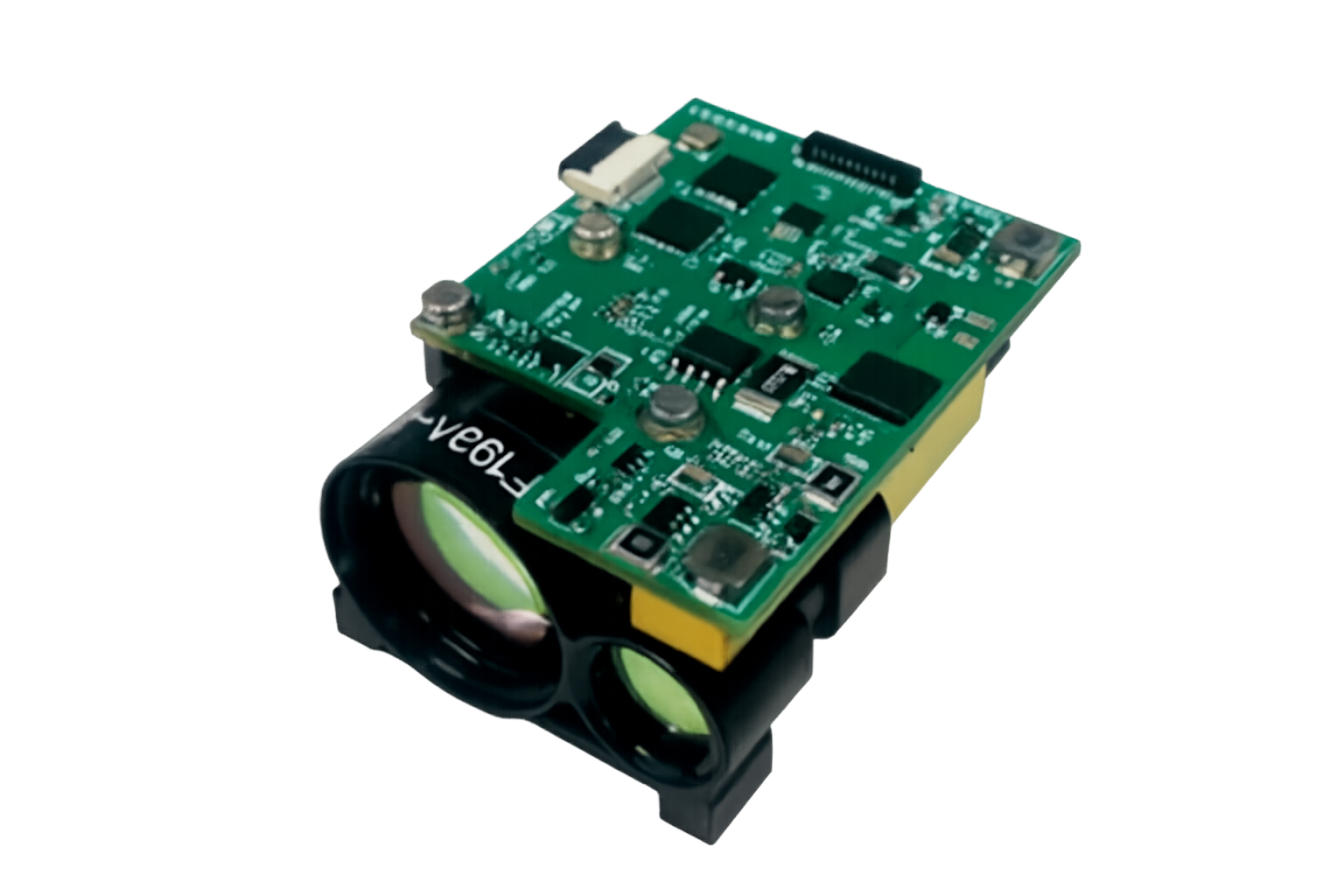
Laser Rangefinder Measurement Accuracy Needs a Reference
Two units can carry the same accuracy figure and still behave differently once installed.
One may be rated against a large diffuse target in clear air. Another may be intended for a smaller target at a shorter distance. If the target and atmosphere are missing, the accuracy figure has far less meaning.
Ask what target was used, how far away it was, and what visibility was present when the range figure was stated.
How Accurate Is a Laser Rangefinder in Real Use?
There is no single number that fits every rangefinder.
A short- or mid-range unit may carry a ±1 m figure. A long-range unit may allow several meters while reaching much farther. The better choice depends on what the host needs from the reading.
If distance is shown only to an operator, a few meters may be acceptable at long range. If the host uses that distance for tighter geometric calculations, a smaller error band can matter more.
The useful question is: how much distance error can your system accept?
Laser Rangefinder Accuracy vs Resolution
Laser rangefinder accuracy vs resolution is one of the most common sources of confusion on a datasheet.
Accuracy is about closeness to the real distance. Resolution is about how finely distance differences can be distinguished. Some suppliers use the term for the smallest reported distance step. Others use it for the spacing needed to separate returns from different surfaces. Check the exact definition before placing two products side by side.
Laser Ranging Accuracy and Resolution Do Different Jobs
Think of a ruler. Fine markings tell you the scale has small divisions. They do not prove those marks are correctly placed.
Laser ranging uses far more complex optics and electronics, but the distinction is similar. Fine resolution does not automatically mean a smaller absolute distance error.
When Range Resolution Becomes Important
Resolution deserves more attention when several reflective surfaces lie close together along the laser path.
Picture a branch in front of a building, a vehicle close to a wall, or a railing crossing the beam. If the ranging electronics can separate closely spaced returns, the host has a better chance of identifying the intended surface.
For a single clear target, absolute distance error may matter more.
Laser Rangefinder Accuracy vs Ranging Success Rate
Laser rangefinder accuracy vs ranging success rate answers two separate questions: when a range is returned, how close is it, and how often do you get one?
Imagine 100 ranging shots. The unit returns 98 usable distances. The ranging success rate is 98%. That tells you nothing about whether those readings are 0.5 m, 2 m, or 5 m away from the real distance.
A high success rate and a tight accuracy band are both useful, but one does not replace the other.
Ranging Success Rate Laser Rangefinder Buyers Need to Read Carefully
Success rate is closely tied to signal strength and target acquisition.
A large light-colored wall usually sends a stronger return than a small dark vehicle near the far end of the operating range. Haze, beam placement, receiver sensitivity, optical-window loss, background light, and vibration can also change how often a usable return is obtained.
When a datasheet states ≥98%, look for the conditions tied to that figure.
A High Success Rate Can Still Come with a Wider Error Band
Getting a distance on 98 out of 100 shots shows that the unit can acquire the target consistently under the stated conditions. It does not say how close each reading is to the real distance.
The reverse can happen too. A unit may give tight readings with a strong return yet lose more shots on a small or dark target.
For tracking work, missed readings can interrupt the distance stream, so ranging frequency and success rate deserve close attention.
What Affects Laser Rangefinder Accuracy?
The target, atmosphere, optics, mounting, and electronics all shape the reading.
Target Size, Surface, and Angle
A large diffuse target is usually easier to range than a small dark object at the same distance. Surface angle matters too. If much of the reflected energy travels away from the receiver, the return becomes weaker.
Glass, polished metal, wet surfaces, vehicle paint, and curved panels can behave very differently from a flat concrete wall. A maximum-range claim should always be tied to the target used for that distance.
Visibility and the Two-Way Optical Path
The laser pulse crosses the atmosphere twice: once toward the target and once back to the receiver.
At short range, light haze may have a modest effect. At many kilometers, the same loss can become far more important. Fog, rain, dust, and poor visibility can weaken the return and lower the chance of a usable range.
Beam Divergence, Pointing, and Platform Motion
Beam divergence determines how quickly the laser spot expands. A narrow beam keeps more energy concentrated on a distant target, but it also leaves less pointing margin.
A small boresight shift may mean little on a large building yet move the spot off a small target several kilometers away. Vehicle vibration, gimbal motion, handheld movement, and target motion add the same kind of challenge.
The Optical Window Can Change Installed Performance
Many OEM products place the module behind a protective window. Material, coating, thickness, clear aperture, tilt, contamination, and position can affect transmission or create stray reflections.
The window belongs in the early integration discussion, not at the end.
Laser Rangefinder Module Accuracy Starts with Timing
A pulsed laser rangefinder sends a short pulse toward the target and measures the round-trip travel time.
Distance = speed of light × round-trip time ÷ 2
Pulse shape, detector response, receiver noise, timing electronics, threshold settings, optical alignment, calibration, and return strength all influence the reported distance. Laser rangefinder module accuracy comes from the complete ranging chain rather than the laser source alone.
1535 nm Laser Rangefinder Accuracy: What the Wavelength Does and Does Not Tell You
Huanxin’s current rangefinder line uses 1535 nm laser ranging across products from 3 km to 20 km.
The wavelength matters for the laser source, receiver choice, coatings, atmospheric behavior, and eye-safety engineering. It does not set the distance error by itself.
Two 1535 nm units can carry different accuracy figures because their pulse characteristics, receiver optics, detector behavior, timing circuitry, beam divergence, and calibration can differ.
Huanxin Product Figures Show Why the Three Metrics Stay Separate
Huanxin Measurement & Control Technology Co., Ltd. manufactures 1535 nm laser rangefinder modules for OEM integration. Its current range covers 3 km, 4 km, 6 km, 8 km, 12 km, 18 km, and 20 km distance classes.
The figures below show why accuracy and ranging success rate should be read separately. The 20K-6520 also lists range resolution as its own item.
*The 20K-6520 page lists ≥17 km for a vehicle-size target and ≥20 km for a large building-type target under stated atmospheric and target conditions.
A 20 km unit can list ±3 m ranging accuracy and ≤50 m range resolution at the same time because those numbers describe different parts of ranging performance.
How to Read a Laser Rangefinder Datasheet Without Chasing One Number
Start with the operating scene, then read the distance-related specifications together.
Ask yourself:
What is the normal working distance?
What is the farthest distance that truly matters?
How large is the target?
Is the surface dark, reflective, wet, angled, or diffuse?
Will the host move?
Is there an optical window?
How often must a distance update arrive?
What distance error can the host accept?
A ±1 m unit is not automatically the better choice if another unit fits the range, target, voltage, size, mass, interface, and pointing conditions more closely.
Choosing the Right Metric for the Job
Different systems place different pressure on the three metrics.
Most real products need a balance. The table is simply a way to decide what to ask first.
Laser Rangefinder Accuracy Should Match the Host, Not Win a Datasheet Contest
A smaller error number looks attractive, but the host only cares whether the incoming distance is useful.
Say one unit offers ±1 m but struggles to stay on a small moving target. Another offers ±2 m yet returns a stable distance stream in the intended scene. If the host can accept a two-meter error, the second unit may be the better fit.
What to Send Huanxin for Module Selection or Customization
Huanxin can adapt selected electrical, mechanical, optical, communication, and performance parameters for OEM projects.
A good module choice starts with the target and host rather than a kilometer label. Once the operating scene is clear, Laser Rangefinder Accuracy, resolution, success rate, beam divergence, frequency, power, and mechanical size can be weighed together. Huanxin Measurement & Control Technology Co., Ltd. can supply standard 3 km to 20 km modules and discuss customization for specific OEM integration needs.
FAQs
1. Is laser rangefinder resolution the same as accuracy?
No. Accuracy tells you how close the reported distance is to the real distance. Resolution tells you how finely distance differences can be distinguished. Fine resolution does not guarantee an equally small absolute distance error.
2. Does a 98% ranging success rate mean 98% accuracy?
No. A 98% success rate means the unit returns a usable distance on roughly 98 out of 100 ranging attempts under the stated conditions. It does not describe the distance error of those readings.
3. Why can two 1535 nm rangefinders have different accuracy?
Wavelength is only one part of the ranging chain. Laser pulse characteristics, receiver optics, detector response, timing circuitry, alignment, calibration, and signal strength can differ between products.
4. Can weather change laser rangefinder measurement accuracy?
Poor visibility can weaken both the outgoing pulse and the return signal. At long distance, haze, fog, rain, and dust can reduce acquisition margin and make ranging less consistent.
5. What should I give a supplier when asking about ranging accuracy?
Send the target type, target size, surface, normal distance, farthest required distance, visibility, host equipment, motion, power, communication interface, available space, optical-window information, and required ranging rate. Those details make it much easier to judge whether a published accuracy figure fits the real operating scene.