How to Choose a Compact Laser Rangefinder Module for EO/IR Integration
Adding laser ranging to an EO/IR payload sounds simple at first. Pick a distance, find a module, connect it to the controller, and put it behind the optical window.
Real projects are rarely that neat.
Inside a compact gimbal, every millimeter has already been claimed by something else. There may be a visible camera, thermal camera, motors, control boards, cables, heat paths and the front window. Weight is just as tight. Move one component a little too far from the rotation axis and suddenly the gimbal needs more torque.
This is why choosing a Compact Laser Rangefinder Module should begin with the payload itself rather than the longest number printed on a datasheet.
A good rangefinder is not simply one that reaches far. It needs to fit, communicate with the host equipment, work through the optical window and stay aligned with the camera during real operation.
Why a Compact Laser Rangefinder Module Matters in EO/IR Equipment
Compact dimensions give an EO/IR engineer more freedom.
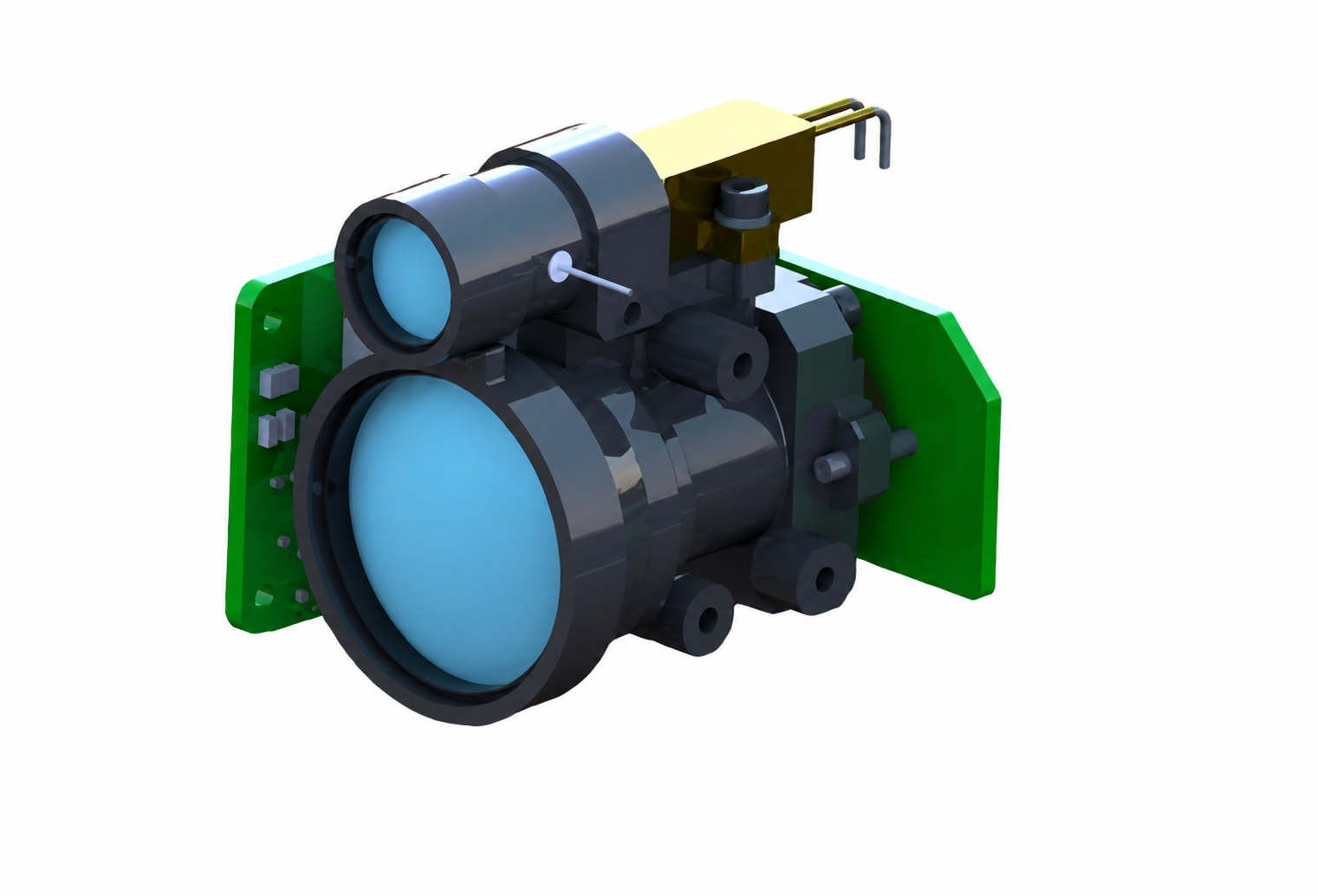
A smaller rangefinder can leave room for a larger thermal core, a better zoom camera, or a more convenient cable path. Lower weight can also reduce the load on the gimbal motors, especially when the laser unit sits away from the center of rotation.
This becomes even more important on airborne equipment. Saving 50 or 100 grams inside a payload may sound minor on a workbench, but that weight moves with the gimbal every second the aircraft is operating.
Compact size also makes enclosure planning easier.
Still, “small” should never be the only buying condition. A tiny unit that needs an awkward connector, draws the wrong voltage or places the optical axis in the wrong location can create more work than a slightly larger unit.
Start With the Payload, Not the Distance Number
Before looking at laser specifications, write down the limits of the EO/IR unit.
You should know:
available internal space;
maximum acceptable weight;
input voltage;
communication interface;
optical window material;
usable clear aperture;
laser mounting position;
camera optical axis;
operating temperature;
expected target distance.
Once these values are clear, product selection becomes much easier.
If the payload only needs reliable ranging around 2–3 km, buying a much longer-range unit may increase weight, volume and power demand without bringing a meaningful benefit.
Think of it like putting a large truck engine into a city car. More power exists on paper, but the rest of the vehicle may never use it.
1535nm Compact Laser Rangefinder Module for EO/IR Systems
1535 nm is widely used in compact eye-safe laser ranging equipment, especially in EO/IR products where small size and low weight matter.
Huanxin Measurement & Control Technology Co., Ltd. offers a 1535 ± 5 nm Er laser rangefinder in its compact product range. The 3 km unit is listed for Class 1/1M eye-safe operation.
The wavelength itself is only part of the decision.
If the rangefinder sits behind a protective window, that window must provide suitable transmission around 1535 nm. A window chosen mainly for visible or infrared imaging does not automatically mean it is ideal for the laser channel.
The coating matters. So does the angle of the window.
A small amount of unwanted reflection may send part of the outgoing laser energy back into the receiver path. That can reduce usable performance or make the optical layout harder to manage.
Compact 3km Laser Rangefinder Module for Small Payloads
A compact 3km laser rangefinder module can be a good fit for small EO/IR pods, handheld optics, vehicle-mounted equipment and lightweight airborne payloads.
Huanxin's 3K-193 unit is listed at:
Those numbers show why the 3 km class is attractive when payload space is tight.
The module is small enough to sit beside other imaging components without forcing the entire gimbal housing to become much larger.
When 3 km Is Enough
Do you really need 8 km if the camera identifies the intended target at only 2 km?
This question is worth asking early.
Laser distance should match the useful working distance of the entire EO/IR package. A rangefinder reaching well beyond the practical observation distance of the camera may add little value.
A 3 km unit often makes sense when the priority is compact packaging rather than extreme reach.
Leave some margin, of course. Just avoid turning maximum distance into the only buying target.
Compact Laser Rangefinder Module for EO/IR: Define the Target First
A laser rangefinder does not measure “3 km” in isolation.
It measures a particular target under particular atmospheric conditions.
A large building wall can return much more laser energy than a small dark object. A vehicle facing the sensor may behave differently from the same vehicle viewed from a shallow angle.
This is why two customers asking for the same distance may need different rangefinder classes.
Before contacting a manufacturer, describe the target as clearly as you can.
Include its approximate size, surface material, color and expected angle.
Reflectivity Changes the Usable Ranging Distance
Laser ranging depends on receiving enough energy back from the target.
Bright, broad surfaces usually return more energy. Dark coatings, irregular surfaces and angled targets may return less.
Glass can behave differently again.
That means the maximum number on a product page should never be treated as a promise for every target.
Huanxin's 3 km unit, as one reference point, uses defined target dimensions, reflectivity and atmospheric conditions for its rated distance.
For an OEM project, sharing the real target is far more useful than simply sending a message that says:
“Need 3 km.”
Weather Changes the Laser Return
Air sits between the rangefinder and the target twice: once on the way out and once on the way back.
Fog, haze, dust, rain and heavy humidity can weaken the returned signal.
A system used in dry inland conditions may behave differently from one mounted on coastal equipment.
This is particularly important for long working distances.
When discussing a project, give the manufacturer realistic environmental information. If the equipment will operate in high humidity or frequent haze, say so at the beginning.
That gives the engineering team a much clearer picture of what the rangefinder will face in actual use.
Choose a Lightweight Laser Rangefinder Module Around the Gimbal
A lightweight laser rangefinder module helps with more than total payload weight.
It also affects balance.
Imagine holding a small weight close to your wrist. Now move the same weight toward your fingertips. It suddenly feels much harder to control.
A gimbal behaves in a similar way.
The farther a component sits from the rotation axis, the more influence its weight can have on motor load and dynamic balance.
This is why the rangefinder's position deserves almost as much attention as the number printed on the scale.
Small Laser Rangefinder Module Placement Inside the Housing
A small laser rangefinder module should have a clear optical path and a rigid mounting surface.
Check the mechanical drawing before you freeze the internal housing.
Pay attention to:
mounting-hole locations;
connector direction;
cable bend radius;
laser-axis position;
nearby camera modules;
available space around the receiver aperture.
Do not forget the cable.
A module may fit perfectly while its connector has nowhere to go. This is one of those small details that becomes expensive when discovered late.
Power Input and Communication Should Be Checked Early
Electrical compatibility is easy to overlook during early product selection because range and size naturally attract more attention.
Yet a mismatch here can stop the integration completely.
The Huanxin 3 km unit uses DC +5 V. Longer-range units may use different supply ranges, so the host power architecture should be checked before ordering.
Look at both normal consumption and the power conditions during ranging.
The rangefinder shares the payload with cameras, motors, processors and sometimes heaters. All of them may draw power at the same time.
Cable length matters too. Thin wires over a long path create voltage drop.
TTL or RS-422 for EO/IR Communication
Huanxin's compact 3 km unit offers TTL and RS-422 options.
TTL can work well for short connections inside compact equipment.
RS-422 is often a better fit when the cable is longer or the electrical environment contains more noise.
There is no universal answer.
Ask these questions instead:
How far is the rangefinder from the main controller?
What interface already exists on the host board?
How much electrical noise is expected?
What baud rate is required?
How will the cable ground be handled?
Keep Host Communication Simple
An OEM project becomes easier when the engineering team receives communication documents early.
The host developer should know how to trigger a ranging command, read the returned distance and identify operating status.
A PC tool can also be useful during early integration.
It lets engineers confirm that the laser unit is communicating correctly before the complete EO/IR assembly is finished.
That saves time because electrical issues can be solved separately from optical and mechanical work.
Optical Window Compatibility Deserves Its Own Check
The protective window is not just a piece of glass in front of the payload.
It becomes part of the laser path.
Its material, coating, thickness and tilt can influence both outgoing and returning light.
Ask the window supplier for transmission data around the laser wavelength.
If your unit uses 1535 nm, you need to know how the window behaves near that wavelength rather than relying only on visible or thermal-band data.
Clear aperture matters as well.
The outgoing beam needs room, but so does the receiving optical path.
Keep the Laser and Camera Looking at the Same Place
A rangefinder is useful only when it measures the target the camera operator thinks it is measuring.
That sounds obvious.
At long distances, though, a small angular shift can move the laser spot a surprising distance away from the camera center.
Mount stiffness, temperature change, vibration and assembly tolerance can all move the relationship between the two optical axes.
A practical EO/IR unit should have a stable mounting reference and a way to check alignment during assembly.
Beam Divergence Is More Than a Datasheet Number
Beam divergence tells you how quickly the laser beam expands with distance.
If the divergence is 0.5 mrad, the beam grows by roughly 0.5 m for every kilometer of travel, before considering the starting beam diameter.
At 3 km, that growth is roughly 1.5 m.
This gives you a rough sense of how large the laser spot may become at long distance.
A smaller divergence can keep more laser energy concentrated on the target.
That sounds ideal, but there is a trade-off.
Gimbal Stability and Beam Size Need to Match
A very narrow beam leaves less room for pointing error.
If a UAV is vibrating, the gimbal is moving or the target is small, the beam may shift away from the intended object more easily.
So do not chase the lowest divergence value automatically.
Look at target size and gimbal stability together.
A laser rangefinder does not work by itself. Its real performance comes from the laser, optics, mount, window and stabilization system working as one package.
Compact OEM Laser Rangefinder Module for Customized Projects
Standard products are useful when the host equipment can accept their existing dimensions and interfaces.
OEM work is different.
A compact OEM laser rangefinder module may need changes to better match a specific EO/IR unit.
Huanxin Measurement & Control Technology Co., Ltd. can provide customized services based on project requirements.
Possible changes may involve:
communication interface;
input voltage;
cable length;
connector arrangement;
mechanical envelope;
mounting details;
selected ranging parameters.
Not every parameter can be changed independently, so it is better to send the full requirement set rather than asking for one change at a time.
Compact Laser Rangefinder for UAV Payload Integration
A compact laser rangefinder for UAV payload equipment must meet stricter weight and packaging limits than many ground systems.
The aircraft adds several extra concerns:
vibration;
changing attitude;
limited power;
moving cable paths;
gimbal balance;
flight endurance.
Low weight helps, but stiffness still matters.
A lightweight module attached to a flexible bracket can lose alignment during flight. The mounting part needs to remain rigid while avoiding unnecessary mass.
The cable should also move freely with the gimbal without pulling on the rangefinder.
Compact Laser Rangefinder Module Checklist for UAV Integration
Before finalizing an airborne payload, check the following items together:
This table is far more useful than choosing purely from a 3 km, 6 km or 8 km label.
What to Send Huanxin Before Requesting a Quote
A clear inquiry saves both sides a lot of email.
Instead of writing only “I need a laser rangefinder,” send the basic engineering requirements together.
A useful inquiry can include:
This information helps Huanxin determine whether an existing unit is suitable or whether a customized version makes more sense.
Choosing the Right Range Class Without Oversizing the Payload
Huanxin offers laser rangefinder modules covering several distance classes from compact short-range units to longer-range products.
The right choice depends on the mission.
A 3 km class may suit compact EO/IR equipment where size and weight have priority.
A longer-range unit may make more sense when the camera can identify useful targets farther away and the platform has enough room, power and weight capacity.
The key is balance.
Do not buy distance that the rest of the payload cannot use.
Do not shrink the rangefinder so much that it cannot cover the real target conditions.
Choose the smallest and lightest unit that still gives the EO/IR package enough ranging margin in the environment where it will actually work.
A Practical Way to Choose Your Compact Laser Rangefinder Module
Start with the payload, then move outward.
First define the available space, weight and power. Next define the target and working distance. After that, check the window, communication interface, beam divergence and optical-axis position.
Only then should you decide which distance class fits best.
That order prevents one impressive specification from controlling the entire purchase.
For Huanxin Measurement & Control Technology Co., Ltd., this kind of project information also makes customization much easier. When the manufacturer understands the target, platform, optics and electrical limits from the beginning, it becomes much easier to match the laser rangefinder to the EO/IR equipment rather than forcing the equipment around the laser rangefinder.
FAQs
1. Is a Compact Laser Rangefinder Module suitable for every EO/IR system?
Not automatically. Compact size is useful when space and weight are limited, but the module still has to match the required distance, target, power supply, communication interface and optical window.
2. Why is 1535 nm often used in compact laser ranging equipment?
1535 nm Er lasers can provide eye-safe ranging in a compact package. They are commonly considered for EO/IR equipment, handheld optics and lightweight airborne payloads. The optical window still needs suitable transmission around this wavelength.
3. Is a 3 km laser rangefinder enough for a UAV gimbal?
It can be. If the camera's useful observation distance is within a few kilometers and the mission does not require longer ranging, a 3 km unit may offer a good balance between size, weight and ranging capability.
4. Should I choose TTL or RS-422?
TTL can suit short internal connections. RS-422 is often preferred when cable runs are longer or the electrical environment is noisier. The host controller should be checked before ordering.
5. Can Huanxin customize the laser rangefinder for my EO/IR project?
Yes. Huanxin Measurement & Control Technology Co., Ltd. can provide customized services for OEM projects. Customers can send their requirements for distance, size, weight, power, communication, window, mounting and production quantity so a suitable configuration can be discussed.