How Target Size, Reflectivity and Visibility Affect Laser Ranging Distance
A laser rangefinder may be sold as a 3 km, 8 km or 20 km module, but that distance should never be read as “this unit will measure every target at this range.”
The real situation is more practical.
Put a large concrete building 8 km away on a clear day, and a rangefinder may have a relatively comfortable job. Replace that building with a small dark vehicle, add haze, and keep the distance exactly the same. The returned laser signal can become much weaker.
Nothing is wrong with the rangefinder. The target and the air between the module and the target have changed.
This is why engineers should look at laser ranging distance together with three basic questions:
How large is the target?
How well does its surface return the laser?
What is the expected atmospheric visibility?
For buyers integrating a laser rangefinder module into an optical payload, handheld optic, vehicle-mounted system or other compact optoelectronic equipment, these questions are usually more useful than asking for maximum distance alone.
Why Laser Rangefinder Target Reflectivity Changes Working Range
The basic idea behind laser rangefinder target reflectivity is easy to understand. The module sends a laser pulse toward an object. Part of that optical energy reaches the target, part of it is returned, and the receiving optics collect a small portion of the returning light.
The receiver does not need all of the emitted energy back. It does need enough usable signal to distinguish the return from background noise.
A target that sends back a stronger signal usually gives the receiver more margin. A surface that sends very little usable energy back makes long-range measurement harder.
That becomes increasingly important as distance grows.
What Happens to the Returned Laser Pulse
Imagine pointing a flashlight at two objects at night: a pale concrete wall and a dark fabric panel.
Your eyes can usually see the wall more easily because more light comes back toward you. A laser rangefinder works on a different optical scale, but the underlying idea is similar.
Surface color alone does not tell the full story. Material, finish, wavelength, surface roughness and angle all affect the returned signal.
A rough painted surface may scatter some light back toward the receiver. A polished metal panel can behave more like a mirror and send much of the beam in another direction.
This is why laser rangefinder target reflectivity should not be treated as a simple light-versus-dark rule.
Surface Angle Matters Too
A reflective surface is not automatically an easy target.
Take a smooth metal plate. If the laser strikes it almost straight on, part of the reflected energy may travel back toward the rangefinder. Tilt the same plate sharply and the return reaching the receiver can fall.
Glass creates another familiar case. A large glass façade may fill the entire laser spot, yet its optical behavior can make the return very different from that of a rough concrete wall.
So when discussing a real application, “vehicle,” “building” or “metal target” may not be enough. Surface finish and likely viewing angle can matter as well.
How Target Size Affects Laser Ranging Distance
Target size affects how much of the laser beam actually lands on the object you want to measure.
Close to the rangefinder, this is rarely difficult to picture. The beam spot is small and a vehicle or wall is large compared with it.
Move the same target several kilometers away and the situation changes. The beam gradually expands because every real laser beam has divergence.
Eventually, part of the spot may extend beyond the target.
Energy that misses the target cannot create the return you wanted.
Target Size Laser Rangefinder Performance at Long Distance
This is where target size laser rangefinder specifications become useful.
A large building gives the laser a generous area to hit. A vehicle offers less. A person, pole, antenna or other narrow object gives even less room.
If your application requires ranging a small object, do not choose a module only because its stated maximum distance matches your required distance.
You need to know what target was used for that range rating.
A module rated for 8 km against a 2.3 m × 2.3 m target is not automatically an 8 km module for every smaller object.
Beam Divergence Changes the Spot Size
Beam divergence describes how quickly the laser beam spreads as it travels.
A rough way to picture it is:
small divergence + long distance = gradually expanding laser footprint
At 500 m, that footprint may still be comfortably smaller than a vehicle. Several kilometers farther away, the spot can become large enough that accurate pointing matters much more.
This creates an interesting trade-off.
A narrower beam can keep more energy concentrated on a distant target, which is useful. It also leaves less room for pointing error. If the payload moves slightly, the spot may shift away from a small target.
For a fixed installation aimed at a building, that may be manageable. For a moving optical payload tracking a distant target, it deserves much more attention.
Visibility Laser Ranging in Clear Air, Haze and Dust
The target is only half of the optical path. The laser also has to cross the atmosphere.
This is why visibility laser ranging conditions matter.
On a clear day, a larger portion of the emitted energy can travel toward the target. In haze, smoke, dust or fog, suspended particles scatter and absorb part of that light.
The same thing happens to the returning signal.
The farther the target is, the longer this atmospheric path becomes.
Why Long-Distance Ranging Is More Sensitive to Poor Visibility
A short-range module measuring an object a few hundred meters away does not ask the pulse to travel very far through the air.
At several kilometers, the situation is different.
Even a moderate drop in atmospheric transmission becomes more important because the optical path is long. A target that produces a comfortable return in clear weather may provide much less margin when visibility drops.
This is why a buyer asking for 10 km or 20 km ranging should not simply say:
“My target is 12 km away.”
A much better description is:
“The target is a vehicle-sized object at up to 12 km, and the normal operating visibility is around 15 km or better.”
Now the supplier has information that can actually be used.
The Laser Has to Travel Through the Air Twice
There is one detail that is easy to forget.
The beam travels from the module to the target.
The reflected signal then travels back.
So an 8 km target creates an optical journey of roughly 16 km for the outgoing and returning light combined.
This does not mean you simply double an atmospheric loss percentage. Real propagation is more complicated than that. It does explain why atmospheric conditions become increasingly important for long-range equipment.
Why Laser Rangefinder Maximum Range Needs Conditions Attached
A laser rangefinder maximum range figure without target and weather information tells you very little.
A useful range specification should be read together with several conditions.
None of these factors works alone.
A large target can still be difficult if it has an unfavorable surface angle. A smaller target may still be ranged successfully if it provides a strong return and the atmosphere is clear.
That is why it makes more sense to think in terms of operating conditions rather than one fixed distance.
Huanxin Range Specifications Show Why Conditions Matter
Huanxin's published product specifications already attach target and atmospheric conditions to maximum measuring distance.
The 3K-193 3 km laser rangefinder module lists a maximum measuring range of at least 3 km under conditions including visibility of at least 10 km, target reflectivity of at least 0.2 and a target size of 2.3 m × 2.3 m.
The 8K-338 follows the same principle. Its published 8 km figure is tied to atmospheric visibility of at least 12 km, a 2.3 m × 2.3 m target and target reflectivity of at least 0.2.
Those conditions are not small print that can be ignored. They tell a buyer what the stated range actually refers to.
Target Size, Reflectivity and Visibility Work Together
It is tempting to ask which factor matters most.
There is no single answer because the three factors interact.
Think of the returned laser signal as a budget.
Target size affects how much of the beam lands where you want it. Reflective behavior affects how much usable light comes back. Atmospheric transmission decides how much energy survives the journey in each direction.
Change two or three of these at once and the practical laser ranging distance can change quickly.
Large Building in Clear Weather
A large building under clear conditions is usually a relatively friendly target.
The building gives the beam plenty of surface area, small pointing errors are less likely to move the whole spot away from it, and clear air helps preserve optical energy.
That does not make every building identical. Glass, polished panels and steep target angles can still change the return.
Small Dark Vehicle in Haze
Now imagine a small vehicle at the same distance.
The laser footprint occupies a larger share of the target area. Platform movement becomes more important. The dark surface may give a weaker return, while haze removes more energy from both directions of travel.
Several unfavorable factors have now been combined.
This is a much more demanding ranging task, even though the distance itself never changed.
Bright but Angled Metal Surface
A bright metal object sounds easy until its geometry enters the picture.
If its surface reflects much of the laser away from the receiver, the useful return may still be weak.
This is a good reminder that laser rangefinder target reflectivity is not the same as how bright an object looks to a person.
For unusual targets, it is worth describing the material and orientation before choosing a range class.
What This Means for Optical Payload Integration
In an integrated optical payload, ranging performance also depends on whether the laser is reaching the same object shown by the imaging channel.
At a few hundred meters, a small alignment error may not cause much trouble.
At several kilometers, that same angular error produces a much larger displacement at the target.
This matters when a narrow laser beam is paired with a high-magnification imaging system.
Optical Windows Can Change the Available Signal
Many laser rangefinder modules operate behind a protective optical window inside a payload or enclosure.
That window becomes part of the optical path.
Window material, coating, clear aperture and installation angle all need to suit the laser wavelength. Poor transmission reduces the amount of emitted and returned energy available to the ranging channel.
Internal reflections can create other unwanted optical effects.
If you already know the window material and coating, send that information to the module manufacturer before finalizing the enclosure.
Boresight Error Becomes More Noticeable at Long Range
The imaging channel may show the target perfectly centered while the laser axis points slightly elsewhere.
At short distance, the offset may still leave the beam on the target. At long distance, the beam may land beside a small vehicle.
This is why long-range integration should consider the laser rangefinder module, optical window, payload pointing accuracy and boresight relationship as one complete optical system.
Choosing a Module for the Target You Actually Need to Measure
When selecting a laser rangefinder, start with the scene rather than the catalogue.
Do you need to measure a building, vehicle, person or another object?
How large is it?
What is the surface like?
How far away is it during normal operation, and what is the farthest distance that really matters?
What kind of weather will the equipment see?
These questions quickly narrow the choice between a compact short-range unit and a longer-range module with more optical margin.
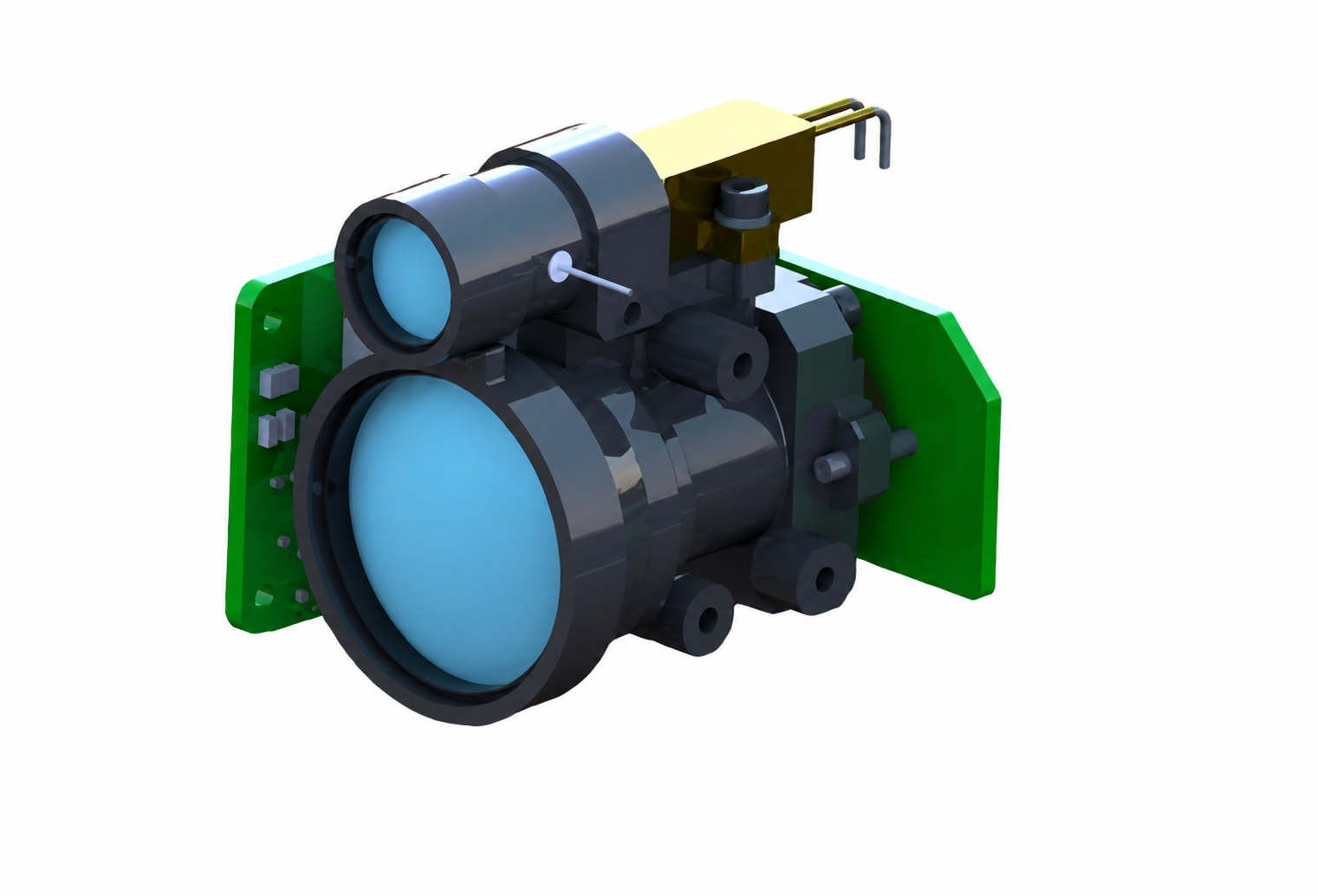
Huanxin Measurement & Control Technology Co., Ltd. offers laser rangefinder modules covering multiple distance classes from 3 km to 20 km for integration into optical payloads and other optoelectronic equipment.
What to Tell Your Laser Rangefinder Supplier
A useful inquiry does not need to be complicated.
This short set of information is far more useful than sending only “Need 8 km rangefinder, please quote.”
When Customization Makes Sense
OEM projects rarely have identical mechanical and electrical requirements.
One customer may have strict weight limits. Another may need a specific communication interface. A third may need the module to work through an existing optical window.
Huanxin Measurement & Control Technology Co., Ltd. can provide customized laser rangefinder module services based on project requirements, including interface, mechanical and selected performance configurations.
For this kind of project, it is better to discuss customization before the payload housing, power architecture and communication system are fixed.
A Better Way to Think About Maximum Range
The number printed next to a laser rangefinder tells you where to start, not where the engineering conversation ends.
A 3 km, 8 km or 20 km rating only becomes useful when you know the target behind that number. Target size determines how much of the laser spot reaches the object. Laser rangefinder target reflectivity affects how much usable energy comes back. Visibility influences how much of that energy survives the trip through the atmosphere.
If your real target is smaller, darker or used in poorer visibility than the stated conditions, build that difference into module selection from the beginning.
It is much easier to choose the right range class before integration than to discover after installation that the catalogue distance and the real operating scene were never the same thing.
FAQs
Does a darker target always reduce laser ranging distance?
Not always, but a surface that returns less usable laser energy can make long-range measurement more difficult. Material, finish, wavelength and target angle matter alongside visible color.
Can a larger target increase laser rangefinder maximum range?
A larger target can make distant ranging easier because more of the expanded laser footprint can remain on the object. Atmospheric conditions, surface behavior and pointing accuracy still matter.
Why does visibility matter more at long distance?
The farther the target, the longer the laser travels through the atmosphere. Haze, dust, smoke and fog can reduce the amount of optical energy reaching the target and the amount that returns to the receiver.
Can two targets at the same distance give different ranging performance?
Yes. A large rough building and a small smooth vehicle at the same distance can return very different signal levels. Size, surface properties, angle and local atmospheric conditions all change the ranging task.
What should I provide when asking Huanxin to select a module?
Send the target type and size, expected surface, normal working range, required farthest distance, typical visibility, payload type, available power, interface, mechanical limits and optical-window information. With those details, the suitable laser rangefinder range class can be narrowed much more accurately.