What to Provide When Requesting a Laser Rangefinder OEM Module Quote
Requesting a laser rangefinder quote sounds simple. Tell the supplier the distance, ask for a price, and wait for an answer.
In real OEM projects, that usually leaves too many blanks.
“We need an 8 km rangefinder” does not tell the manufacturer what kind of target you are measuring, how large it is, what the surface looks like, how clear the air is, or how the module will fit into your equipment. It also says nothing about voltage, communication, available space, weight, mounting, or the optical window in front of the laser.
Those details can change which product is suitable.
Huanxin Measurement & Control Technology Co., Ltd. manufactures 1535 nm laser rangefinder modules for OEM integration, covering different distance classes for compact, medium-range, and long-range equipment. Customized configurations can also be discussed when customers have specific electrical, communication, mechanical, or optical requirements.
If you want a useful quotation rather than a generic price list, the RFQ should describe the job the rangefinder actually needs to do.
Why a Laser Rangefinder OEM Module Quote Needs More Than Maximum Range
Maximum distance is normally the first specification buyers mention. It should not be the only one.
A laser pulse has to travel through the atmosphere, reach the target, reflect from its surface, travel back through the air, and enter the receiver with enough signal strength to produce a usable distance reading.
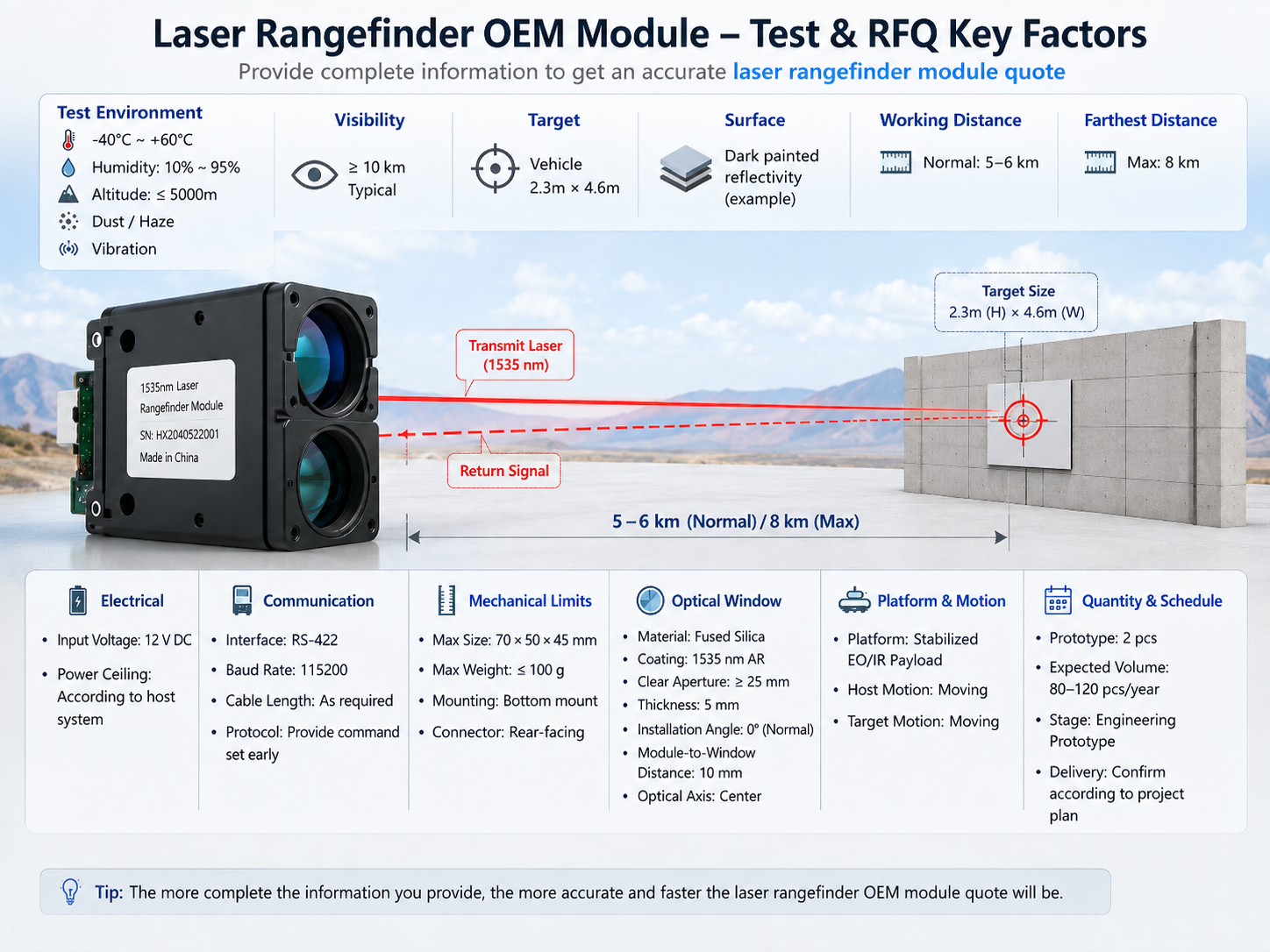
That means two targets at the same distance may behave very differently.
A large building at 6 km is not the same ranging task as a small dark object at 6 km. A vehicle in clear weather is not the same case as the same vehicle in haze.
This is why a laser rangefinder module quote should be based on operating conditions rather than a distance number alone.
Start Your Laser Rangefinder OEM Module RFQ With the Target
The first thing to describe is what you actually want to measure.
Tell the supplier whether the target is a vehicle, building, person-sized object, tower, vessel, terrain feature, target board, or another object. If possible, give its approximate width and height.
Target size matters because the beam becomes wider as distance increases. At long range, only part of the beam may fall on a smaller object.
A supplier who knows the target dimensions can judge the required ranging margin far more accurately than one who receives only “8 km required.”
Describe the Target Surface Too
The name of the target is only part of the story.
One vehicle may have a light painted surface. Another may be dark, dusty, covered with glass, or finished with a low-reflectivity coating.
Those surfaces do not return the same amount of laser energy.
If you already know the approximate reflectivity, include it in the inquiry. If you do not, describe the material and finish in simple words.
“Dark painted vehicle body” is already more useful than simply writing “vehicle.”
Tell the Laser Rangefinder Module Manufacturer Two Distance Numbers
Instead of sending only the maximum range, provide:
your normal working distance;
the farthest distance that must actually be reached.
Imagine a system that normally operates between 1.5 and 3 km but occasionally needs 4 km. That requirement is quite different from equipment expected to work close to 4 km during most operations.
The distinction helps the supplier choose a module with sensible margin rather than simply moving you into the longest-range product available.
Do Not Select a Laser Rangefinder OEM Module by the Biggest Number
A longer distance specification is not automatically better.
As the required range increases, the module may need more laser energy, more power, a larger optical structure, or additional space inside the host equipment.
That can influence:
module weight;
host power consumption;
available installation space;
thermal load;
optical aperture;
overall payload balance.
If your equipment is compact, extra range that will never be used may create more integration work without adding real value.
The better question is:
What distance class gives enough margin for the target and conditions I actually have?
Include Visibility and Real Working Conditions
Atmospheric conditions become increasingly important as ranging distance grows.
Haze, humidity, dust, mist, and poor visibility can weaken the returned signal. The laser also travels through the atmosphere twice—out to the target and back to the receiver.
For outdoor equipment, it is worth telling the supplier what the air is normally like where the system will operate.
Give Typical Visibility, Temperature, Humidity, and Altitude
Useful information can include:
typical visibility in kilometers;
minimum operating temperature;
maximum operating temperature;
humidity;
altitude;
dust or haze;
salt-air exposure;
expected vibration.
Try to describe realistic operating conditions rather than the harshest environment imaginable.
If one condition is mandatory, mark it clearly.
A requirement such as “operation from -40°C to +60°C is mandatory” is much easier to work with than “must work outdoors.”
Tell the Supplier Whether the Host or Target Moves
A stationary rangefinder measuring a stationary target is very different from a module installed in moving equipment.
Tell the supplier whether the unit will be installed in:
handheld optical equipment;
a stabilized EO/IR payload;
vehicle-mounted optics;
fixed observation equipment;
airborne optical equipment;
another moving or stationary host.
Then explain whether the target moves.
Pointing Stability Matters More at Long Range
Beam divergence is often shown as a small value in milliradians. On paper, the number may look tiny.
Several kilometers away, that angle becomes a much larger laser spot.
A small pointing error can also move the spot away from a narrow target. This makes boresight, mounting stiffness, vibration, and host stabilization increasingly important for long-distance ranging.
If you know your host's pointing tolerance or stabilization accuracy, send it with the inquiry.
Electrical Details for a Laser Rangefinder OEM Module Quote
A module can meet the optical requirement and still be difficult to integrate if the electrical specifications do not match the host.
Power details should be discussed early.
Provide the Available Input Voltage
Tell the manufacturer what voltage is already available inside your equipment.
If the host has a strict current or power ceiling, provide that too.
It is also useful to state whether the rangefinder has a dedicated power rail or shares power with cameras, processors, motors, or other devices.
In compact equipment, this can affect which configuration makes the most sense.
Tell the Supplier How Often You Need to Range
Single-shot ranging and continuous ranging are not the same operating case.
Instead of asking only for the highest repetition frequency, describe how the product will actually be used.
You might write:
1–2 measurements per second during normal operation.
Or:
Continuous ranging is required while the host tracks a moving target.
That gives the engineer a much clearer picture.
Communication Requirements for a Laser Rangefinder OEM Module
Communication is sometimes left until late in the project because buyers focus first on distance and size.
That can create unnecessary work.
TTL and RS-422 are common interface choices for OEM ranging modules. Which one fits your system depends on your controller, wiring arrangement, cable length, and electrical environment.
Provide Interface, Baud Rate, Cable, and Connector Needs
If the host controller is already selected, send as much of the following as you know:
TTL, RS-422, or another required interface;
baud rate;
cable length;
connector type;
connector direction;
required command functions;
preferred data format.
If the interface is still open, say so.
The manufacturer can then suggest an option based on the rest of the equipment.
Ask for the Communication Protocol Early
Do not wait until the mechanical parts are finished before looking at the command protocol.
Ask for the command set, returned distance format, status fields, operating commands, and any available PC software during the early integration stage.
Your software engineer can then work on host communication while the mechanical work continues.
Mechanical Limits for a Custom Laser Rangefinder Module
Mechanical fit is often where OEM projects become very specific.
A standard product may meet the distance requirement perfectly but be 5 mm too tall for the available cavity. In a compact optical payload, 5 mm can be a serious issue.
Provide Maximum Size, Weight, and Mounting Limits
Send the maximum acceptable:
length;
width;
height;
weight.
If one dimension is especially restrictive, point it out.
Mounting information is useful too. This may include the mounting face, screw positions, allowable screw depth, connector direction, and preferred optical-axis location.
A basic dimensioned drawing can often explain this faster than a long email.
Tell the Manufacturer What Can Change
Not every requirement has the same priority.
Perhaps 12 V input is fixed, while the connector can move.
Perhaps RS-422 is required by the main controller, while the mounting bracket can still be changed.
Perhaps the outer housing is already frozen, but the internal module position remains adjustable.
Making these boundaries clear helps the manufacturer focus customization work on areas where changes are still possible.
Optical Window Details Can Affect the Laser Rangefinder OEM Module
Many OEM systems place the ranging module behind a protective optical window.
That window becomes part of the laser path.
If the material, coating, clear aperture, angle, or position is unsuitable, some outgoing and returning laser energy may be lost. The module could perform well during bench operation yet lose ranging margin after installation.
What Optical Window Information Should You Provide?
If the window has already been selected, send the following information.
For a 1535 nm ranging system, transmission around the working wavelength needs particular attention.
Do Not Treat the Window as Ordinary Cover Glass
A transparent cover is not automatically a suitable laser window.
The material may transmit visible light well while performing differently at the laser wavelength. Coating choice can change optical loss too.
The aperture also needs to leave enough space for both transmit and receive paths.
If your window has not yet been selected, discussing it with the rangefinder supplier before freezing the host structure can save a lot of rework later.
How Customization Affects a Laser Rangefinder Module Quote
A custom laser rangefinder module does not necessarily mean developing a completely new ranging unit.
In many OEM projects, the optical core can remain largely unchanged while several integration details are adapted to the host.
Possible customized items may include:
communication interface;
connector;
cable length or direction;
input voltage;
mounting arrangement;
housing dimensions;
selected operating parameters;
optical-axis position;
optical-window integration.
Separate Must-Have Items From Preferred Items
One simple trick makes an RFQ much easier to read: tell the supplier which requirements are mandatory.
This helps the laser rangefinder module manufacturer see where there is room to adjust the product.
It can also prevent a preferred feature from accidentally ruling out an otherwise suitable module.
Include Quantity in Your Laser Rangefinder Module Quote Request
Quantity is not only a pricing question.
A two-piece prototype order can involve different preparation from regular production. The first units may need special cables, interface confirmation, drawings, or mechanical changes.
If the project later moves into regular production, a more optimized configuration may become worthwhile.
Provide Prototype Quantity and Expected Production Volume
If possible, provide both.
A useful line might be:
2 units for prototype integration, followed by an estimated 50–100 units per year after customer acceptance.
That tells the manufacturer much more than:
Please quote 2 pcs.
Add Your Project Stage and Required Delivery Date
Tell the supplier where the project currently stands.
Are you:
selecting components;
building an engineering prototype;
preparing field evaluation;
replacing an existing rangefinder;
preparing for regular production?
Then state when the first hardware is needed.
This allows the supplier to match technical communication and delivery planning to the actual project.
A Practical RFQ Table for Laser Rangefinder OEM Projects
You do not need a twenty-page specification document for the first inquiry.
A clear one-page RFQ is often enough.
Do not worry if every field is not known yet.
Writing “open”, “not fixed yet”, or “please advise” is much better than inventing a specification that may later change.
What Does a Good First RFQ Look Like?
Compare these two inquiries.
The first says:
We need an 8 km laser rangefinder. Please send your price.
There is nothing wrong with asking that question, but the supplier will probably need several follow-up emails.
A much stronger inquiry might read:
We are developing a stabilized optical payload and need a 1535 nm ranging module. The main target is a vehicle approximately 2.3 m wide and 4.6 m long. Normal working distance is 5–6 km, while 8 km is required at the far end. Typical visibility is above 10 km. Host power is 12 V and communication is RS-422. Available installation space is approximately 70 × 50 × 45 mm with a 120 g weight ceiling. The module will operate behind a coated optical window. We need two units for prototype integration and expect approximately 80–120 units per year if the project enters regular production.
Now the engineer has something concrete to work with.
It takes only a few extra minutes to prepare that information, yet it can remove several rounds of back-and-forth email.
What Should a Laser Rangefinder Module Manufacturer Ask You?
Do not be surprised if a supplier replies with more questions before sending the final configuration.
That can be a good sign.
If the target is unclear, the engineer may ask about dimensions or surface. If the requested distance is near the upper end of a product class, visibility may need to be confirmed. If the module sits behind a window, transmission or coating information may be requested.
These questions help connect a datasheet number with a real installation.
Ask What Conditions Sit Behind the Published Range
When a product page says 3 km, 8 km, 12 km, or 20 km, you should know what the number refers to.
Ask about:
target type;
target size;
expected reflectivity;
atmospheric visibility;
other conditions linked to the ranging distance.
Maximum range should not be read as a promise that every object can be measured at that distance in every environment.
Ask Which Parts Can Be Customized
If a standard module is close to what you need, it is worth asking what can be changed before moving to another product.
Possible items may include communication, connector, cable, voltage, mounting, mechanical envelope, or selected operating settings.
That is where laser rangefinder OEM cooperation becomes useful.
The best module for an OEM project is not always the one with the largest number on the datasheet. It is the one that reaches the required target, fits the available space, talks to the host controller, works with the power system, and leaves enough margin for real operating conditions.
Before You Send Your RFQ
A useful RFQ paints a picture of the ranging job.
Distance is only one part. Target size, target surface, visibility, motion, power, communication, available space, optical window, quantity, and schedule fill in the rest.
When those details arrive together, a manufacturer can move beyond sending a generic price and begin discussing a configuration that actually fits the equipment.
Huanxin Measurement & Control Technology Co., Ltd. provides 1535 nm laser rangefinder modules for OEM integration and can work with customers on electrical, communication, mechanical, and optical requirements. If you are preparing a new product, start by sharing the real host limits and the real target conditions. That usually makes the quotation process faster and makes later integration much easier.
FAQs
What should I provide first when requesting a laser rangefinder OEM module quote?
Start with the target type and size, normal working distance, farthest required distance, visibility, host equipment, available voltage, communication interface, size and weight limits, optical-window details, and expected quantity. These details give the supplier enough information to narrow the suitable product class.
Can I request a quote if some specifications are still unknown?
Yes. Mark undecided items as open and tell the supplier which requirements are already fixed. Connector choice, mounting, optical-window details, or final production quantity may still be flexible during early development.
Why does target reflectivity matter for ranging distance?
The receiver relies on laser energy returning from the target. A large light-colored surface may return more usable energy than a small dark surface at the same distance. Describing the surface helps the supplier judge how much ranging margin may be needed.
When should I ask for a custom laser rangefinder module?
Customization is worth discussing when a standard product meets most of the ranging requirements but does not fit the host electrically or mechanically. Voltage, communication, connectors, cables, mounting, dimensions, and optical integration are common areas to discuss.
Should I send a mechanical drawing with my inquiry?
It is not always necessary for the first email, but it can be very useful when installation space is tight. A simple drawing showing the available envelope, mounting surface, optical-axis position, connector direction, and optical-window aperture can prevent misunderstandings before prototype integration begins.