How Atmospheric Extinction, Fog, and Rain Impact 1535nm Laser Ranging Distance
Anyone operating electro-optical gear in the field knows the frustration: on a crisp day, your rangefinder locks onto targets 10 kilometers out with ease, but the moment a sea fog rolls in or clouds open up, returns get flaky or cut out entirely.
Air is never just empty space. Photons leaving your transmitter collide with water droplets, dust, aerosols, and fluctuating temperature layers. To build reliable targeting, surveillance, or reconnaissance systems, you have to understand exactly how the 1535nm wavelength behaves across diverse weather conditions—and where its physical boundaries lie.
Why 1535nm Erbium-Glass Dominates Long-Range Ranging
Legacy tactical rangefinders frequently relied on 905nm or 1064nm bands. While effective under dry conditions, both come with severe limitations:
905nm diodes face strict pulse power ceilings to prevent ocular damage. Low pulse energy directly impairs penetration through adverse weather.
1064nm Nd:YAG lasers deliver high energy, but their retinal hazard zone demands extensive safety buffers, making them unsuitable for widespread troop deployment or commercial integration.
1535nm erbium-glass lasers solve this tradeoff.
The human cornea and lens absorb 1535nm radiation before it strikes the retina. Because of this Class 1 eye-safe profile, transmitters can unleash significantly higher peak energy per nanosecond pulse without risking blindness to nearby personnel. That extra energy translates directly into link margin when punching through thick air.
1. Molecular Absorption
Air molecules (primarily $\text{H}_2\text{O}$ and $\text{CO}_2$) absorb photon energy at specific resonance frequencies. Fortunately, 1535nm sits inside a clean short-wave infrared (SWIR) transmission window, flanked by steep water absorption bands at 1400nm and 1900nm. Even in high tropical humidity, molecular absorption at 1535nm remains negligible compared to particulate scattering.
2. Particle Scattering
Scattering physically deflects photons away from the optical path, preventing them from hitting the target or returning to the receiver aperture. The severity of scattering depends on the ratio between the particle size and the laser’s wavelength ($1.535\,\mu\text{m}$).
Fog vs. Rain: Which Degrades Ranging More?
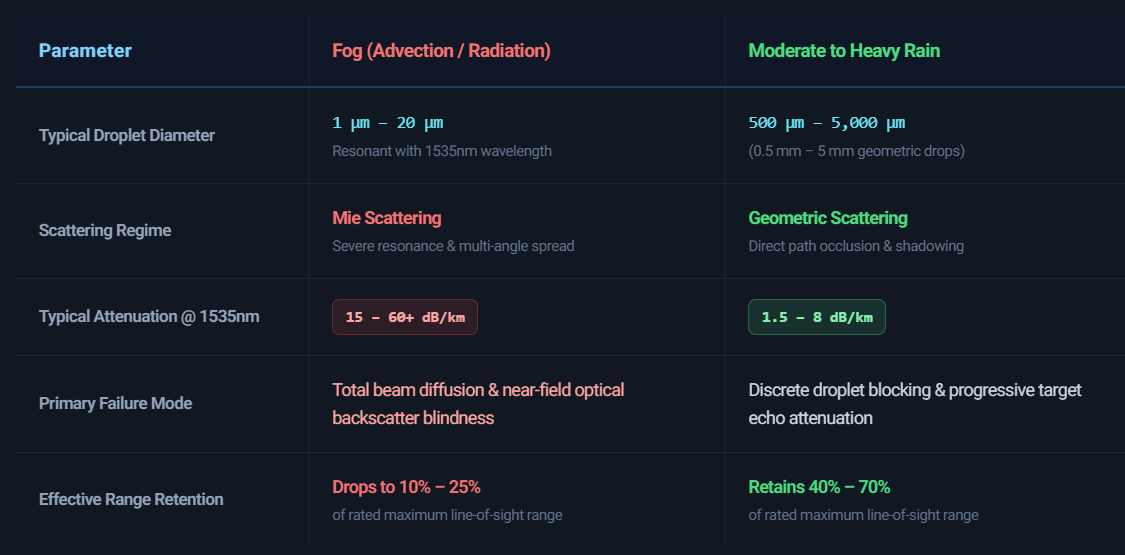
Many field teams assume heavy downpours degrade laser signals worse than silent mist. In reality, fog is far more destructive to infrared beams than rain.
How Fog Affects 1535nm Laser Rangefinders
Fog droplets hover between 1 and 20 microns—matching the $1.535\,\mu\text{m}$ wavelength almost 1:1. This triggers intense Mie scattering, which scatters photons forward and backward into a diffuse halo.
Critically, near-field fog droplets reflect light straight back into the receiver lens, creating strong optical backscatter that can overwhelm the photodetector before it registers distant echoes.
Why Rain Leaves More Usable Signal
Raindrops measure in millimeters—hundreds to thousands of times larger than the laser wave. They operate in the geometric optics regime, acting as discrete physical obstructions rather than resonant scatterers. Because a laser beam broadens into a cone over long distances, light simply sweeps around individual falling drops, losing power at a steady, manageable rate.
Engineering Solutions for Harsh Weather Ranging
You cannot change the weather, but smart optomechanical and firmware design can recover usable signal margins.
Hardware Range Gating: Fog backscatter occurs predominantly in the first 50 to 100 meters. By programmatically disabling the detector for the initial few hundred nanoseconds after pulse release, the unit ignores local glare and stays receptive to distant returns.
Multi-Echo & Last-Pulse Logic: Raindrops and light foliage trigger early, low-amplitude return spikes. Multi-target firmware filters these out and locks exclusively onto the final high-energy return of the solid background target.
High-Sensitivity InGaAs Avalanche Photodiodes (APDs): Paired with low-noise transimpedance amplifiers, high-quantum-efficiency APDs pull faint pulses out of noisy baselines.
Hermetic Enclosures: Temperature shocks cause internal condensation. Sealed chambers backfilled with dry nitrogen alongside sapphire front windows protect line-of-sight clarity in marine salt-spray and monsoon conditions.
Custom Solutions from Huanxin Measurement & Control
At Huanxin Measurement & Control Technology Co., Ltd., we design and produce high-performance laser rangefinder modules tailored for integration into pods, UAV gimbals, vehicle turrets, and handheld observation sights.
We understand that standard catalog modules don't always fit specialized mission profiles. We offer extensive OEM/ODM engineering customization:
Custom Pulse Energies & Repetition Rates: Optimized for high-speed tracking or ultra-low power consumption.
Tailored Divergence Optics: Narrow beam divergence for pinpoint long-range targeting, or broader cones for fast search-and-track.
Firmware-Level Filtering: Proprietary multi-target discrimination algorithms designed specifically for coastal fog, dust, and rain.
FAQs
Why does a 10km rangefinder struggle at 2km in pea-soup fog?
Signal decay over distance follows the exponential Beer-Lambert relation. In heavy fog, attenuation easily hits $30 - 50\,\text{dB/km}$. Because rangefinding requires a round trip, a pulse faces double the attenuation loss, rapidly draining even high-energy pulses before they can bounce back.
Does 1535nm penetrate fog better than 905nm?
Yes. While both wavelengths experience Mie scattering in dense fog, 1535nm benefits from a significantly higher permissible pulse energy under Class 1 eye-safety rules. That extra link margin allows 1535nm units to punch deeper into light-to-moderate haze than low-power 905nm diodes.
What is the advantage of last-target mode in rain?
In rain, droplets reflect tiny portions of light back early in the measurement window. Last-target mode instructs the signal processor to disregard these early low-amplitude returns and register distance based solely on the final, strong echo from the physical target.
Does relative humidity alone impact 1535nm rangefinders?
Invisible water vapor causes minimal attenuation at 1535nm because the wavelength sits inside a clear atmospheric transmission window. Measurable drop-offs occur only when vapor condenses into physical water droplets (mist, cloud, or fog).