Class 1 Eye-Safe Certification for 1535nm Laser Rangefinders: IEC 60825 Explained
Picture a long stretch of coastline or an open field where an operator triggers a rangefinder. A beam shoots out, bounces off a hull or vehicle twenty kilometers away, and returns within microseconds. If that burst were coming from a legacy 1064nm emitter, anyone glancing toward the source could suffer permanent vision damage in an instant. Yet, switch to a 1535nm Erbium-glass emitter, and people standing right in the path can look directly down the line of sight without flinching.
Balancing raw output with human ocular safety is one of the toughest challenges optronics engineers face. You need enough millijoules to pierce through fog, sea spray, and dust, but you cannot endanger personnel, spotters, or civilians. Achieving an accredited class 1 eye safe laser rating settles this problem, transforming high-output field gear into a safe, deployable tool.
Demystifying the Beam: What Makes a Class 1 Eye Safe Laser?
Lasers carry a reputation built on industrial cutting torches and sci-fi weaponry, but safety ratings evaluate real-world tissue thresholds rather than raw power alone. A Class 1 label represents the safest operational tier recognized globally. When an optical assembly receives this rating, it guarantees that emitted light stays within biological safety limits across all realistic working states, including direct, prolonged viewing into the aperture.
A Class 1 rating does not mean the beam carries no energy. Instead, it confirms that the combination of wavelength, divergence angle, and pulse timing keeps biological exposure harmless. Integrating an accredited unit into an uncrewed aerial vehicle pod or a handheld viewer lets you bypass cumbersome interlock keys, heavy eyewear, and restricted safety zones.
How Human Vision Interacts with Invisible Infrared Emission
The human eye functions like a camera with an organic focusing array. Light enters through the cornea, moves through the fluid-filled anterior chamber, passes the lens, and lands directly on the retina. Visible light and near-infrared bands (roughly 400nm to 1400nm) pass through these clear structures effortlessly.
The eye’s natural focusing power concentrates those incoming waves onto the retina by roughly 100,000 times. A weak 905nm or 1064nm stray beam turns into a microscopic, high-intensity focal point on the macula, searing sensitive photoreceptors without triggering a blink response.
Once light shifts beyond 1400nm into the short-wave infrared spectrum, the physics changes completely. Water molecules and cellular proteins in the cornea and front chamber absorb the photons before they can ever touch the retina. The outer surface of the eye disperses this energy across durable tissue capable of rapid regeneration, eliminating the danger of deep retinal scarring.
Is 1535nm Laser Safe for Eyes Under Everyday Working Conditions?
Field operators frequently ask: is 1535nm laser safe for eyes during routine deployments? Under standard field protocols, the answer is yes.
Because the cornea absorbs 1535nm light quickly, the threshold for tissue damage sits thousands of times higher than it does for 1064nm Nd:YAG emitters. This spectral behavior allows Erbium-doped phosphate glass lasers to emit powerful pulses across vast distances while remaining harmless to anyone nearby.
Navigating the IEC 60825-1 1535nm LRF Regulatory Landscape
Building an inherently safe system is only half the battle; certifying it for international distribution requires clearing strict regulatory hurdles. Global compliance relies on the International Electrotechnical Commission framework. Every commercial and defense sensor platform distributed in Europe, the Americas, and Asia must meet the requirements of an IEC 60825-1 1535nm LRF audit.
Auditors evaluate more than just a single pulse. They test for biological effects across multiple operating states, reviewing peak pulse limits, thermal build-up from repetitive firing, and continuous exposure windows.
Decoding Accessible Emission Limits Across Operating Regimes
The core metric inside the IEC framework is the Accessible Emission Limit (AEL). This value sets the maximum permissible optical power or pulse energy that can exit an aperture at a given distance. Evaluators check three distinct criteria:
The Single-Pulse Check: Ensures an isolated flash contains less energy than the maximum threshold permitted for that brief exposure window.
The Average Power Check: Evaluates prolonged emission to confirm thermal build-up over 10 to 100 seconds stays within safe tissue dissipation limits.
The Pulse Train Check: Accounts for systems firing rapidly (such as 1Hz to 20Hz bursts), scaling down the allowable energy per pulse to avoid cumulative biological heating.
A sensor that easily passes a single-shot test can still fail certification if high repetition rates cause heat to build up beyond allowable thresholds.
Class 1 vs Class 1M Laser Rangefinder Standard: Spotlight on Optics
Teams often confuse classifications when evaluating the class 1 vs class 1M laser rangefinder standard. Both ratings mean an unaided human eye can safely look into the beam without injury. The difference emerges the moment an observer views the emitter through binoculars, a monocular, or a rifle scope.
Class 1: Completely safe for both the naked eye and anyone looking through magnifying binoculars or spotting scopes.
Class 1M: Safe for the naked eye because of a wide beam divergence. Magnifying optics collect that wide beam, concentrate it, and focus hazardous energy into the eye.
For systems deployed in border zones, ports, or forward areas where spotters and observers routinely scan with binoculars, insisting on a true Class 1 certification avoids accidental exposure incidents.
The Physics of Human Tolerance: MPE Maximum Permissible Exposure 1535nm
Accessible Emission Limits are based on biological tolerance tables known as the MPE maximum permissible exposure 1535nm. The MPE defines the maximum exposure skin or eyes can absorb without experiencing reversible or permanent biological changes.
Because human cornea tissue is saturated with water, 1535nm photons cannot reach the internal lens. For short nanosecond pulses, the corneal MPE at 1535nm is roughly 1,000 J/m², whereas visible and near-infrared wavelengths are restricted to roughly 5 J/m². This generous margin allows long-range rangefinders to punch out powerful megawatts of peak energy over 5 to 15 nanosecond pulses without risking eye injury.
Meeting Eye Safe Laser Rangefinder Certification Requirements for OEM Modules
Securing compliance involves far more than running calculations on paper. Real-world testing requires consistent physical and mechanical performance. Meeting eye safe laser rangefinder certification requirements demands tight integration between optical coatings, drive electronics, and mechanical packaging.
Safety auditors evaluate the beam at set distances, searching for hot spots, non-uniform energy distribution, or stray internal reflections that could escape the housing.
Aperture Testing and Optical Profiling
Official testing uses strict hardware setups to simulate both human eyes and optical gear:
7mm Aperture Setup: Simulates a fully dilated pupil in low light. A 7mm sensor is placed 100mm from the front window; energy passing through must not exceed the Class 1 threshold.
50mm Aperture Setup: Simulates an observer holding 7x50 binoculars 2 meters away, verifying that light collected by large lenses remains at safe levels.
Hotspot Analysis: Solid-state rods can project uneven energy rings. Auditors map the beam cross-section with high-resolution profilers to confirm no single spot spikes past allowable energy limits.
Circuit Protections and Single-Fault Safety
IEC compliance requires that equipment remains safe even when internal components fail. If a driver MOSFET shorts out or the controlling microprocessor hangs, the system must not emit continuous, unregulated radiation. Robust hardware protections include:
Hardware Watchdog Timers: Dedicated circuits that cut primary power if the firmware locks up mid-transmission.
Discharge Capacitance Limits: Energy storage banks sized so they cannot physically sustain a continuous arc if switching gates fail closed.
Optical Feedback Diodes: Internal pick-off detectors that monitor pulse shapes in real time, shutting down high-voltage power if pulse energy or frequency drifts.
OEM Integration: Modules from Huanxin Measurement & Control
Designing a laser transmitter from scratch is costly, complex, and time-consuming. Aligning optical axes, keeping the unit stable from freezing cold to scorching heat, and managing regulatory audits can easily delay a launch. Partnering with a specialized OEM manufacturer streamlines the path to market.
Huanxin Measurement & Control Technology Co., Ltd. develops rugged Laser Rangefinder Modules for mission-critical integration. Using proprietary Erbium-glass technology, these modules cover distances from 3 kilometers out to beyond 20 kilometers while delivering certified eye-safe operation.
Size, Weight, Power, and Custom Interfaces
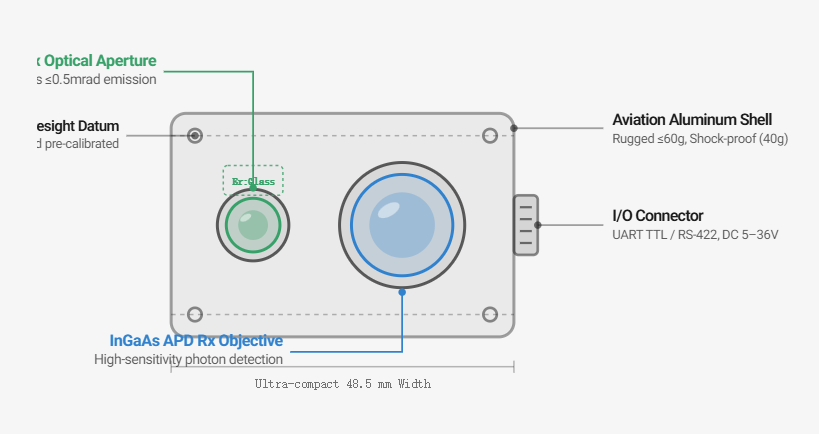
Payload engineers face tight SWaP constraints. Every excess gram on an aerial gimbal shortens battery endurance, while surplus heat can blur thermal imaging channels. The compact 3K-193 module weighs just 60 grams and measures 48.5 × 36 × 26 mm, yet delivers rapid readings in under half a second while filtering out visual clutter like tree cover and dust.
Because standard catalog parts do not fit every mechanical layout, Huanxin provides tailored customization services:
Boresight Alignment: Precision mechanical datums align the beam axis to daytime and thermal sensors within <0.2 mrad.
Electrical Protocols: Direct support for standard 3.3V/5V TTL UART or differential RS-422 connections to prevent interference over long internal wiring harnesses.
Custom Beam Shaping: Adjustable beam divergence from 0.3 mrad to 0.7 mrad to balance narrow long-range spots against rapid target capture on moving objects.
Partnering with an experienced manufacturer gives you drop-in modules that are factory-calibrated, shock-rated up to 40g, and fully compliant with international eye-safety standards.
Frequently Asked Questions
Can looking through a spotting scope at a 1535nm laser injure your eye?
If the device holds a certified Class 1 rating under IEC 60825-1, it is safe to view through common optical gear like binoculars or spotting scopes. If it holds a Class 1M rating, the wide beam can be concentrated by lenses into a hazardous exposure.
Why choose 1535nm instead of 905nm for long-distance targeting?
Light at 905nm poses a retinal hazard, forcing emitters to run at low peak powers that struggle beyond 1 to 2 kilometers in haze or fog. By contrast, 1535nm light is absorbed harmlessly by the cornea, allowing for much higher pulse energy that easily reaches 10 to 20 kilometers while remaining eye-safe.
Do dust and rain affect field eye safety?
Dust, rain, and humidity scatter and attenuate optical energy, which actually lowers the exposure level downrange. Extreme heat can cause pump diodes to drift in efficiency, which makes solid internal thermal management essential for maintaining consistent pulse timing.
Does an eye-safe OEM module guarantee that the host product is certified?
Using an eye-safe OEM sub-assembly simplifies the process, but the fully assembled host platform still needs final testing. Outer protective windows, enclosure baffles, or custom firmware can alter beam profiles, meaning the finished device must be verified as a complete unit.
How are customized modules checked for eye safety prior to shipping?
Each custom module undergoes comprehensive optical bench testing. Technicians measure pulse widths, check spatial beam profiles, and audit emission levels across a wide temperature range of -40°C to +65°C to ensure every unit meets Class 1 accessible emission limits before delivery.