Integrating 1535nm Laser Rangefinders into C-UAS Tracking Systems
Small commercial drones have completely changed perimeter defense. What used to be a simple radar sweep now involves picking up low-flying, carbon-fiber quadcopters with tiny radar cross-sections.
Radars and wide-angle thermal cameras excel at initial wide-area detection. But when you need to hand off that track to a directional jammer, high-energy laser, or net-gun interceptor, an approximate track is not enough. You need precise 3D slant range updated multiple times per second.
Integrating a dedicated counter-drone laser rangefinder into your electro-optical/infrared (EO/IR) turret gives the tracking computer the high-rate distance data needed to calculate true target velocity, lead angle, and point of intercept.
Why 1535nm Erbium Glass Outperforms Legacy Wavelengths
Selecting the operating band for a target-tracking payload comes down to atmospheric transmission, receiver sensitivity, size, and operator safety.
Older short-range solutions typically leaned on 905nm semiconductor diodes, while military-grade targeting historically used 1064nm Nd:YAG crystals. Today, using a 1535nm laser for dynamic target tracking is the industry standard for tactical drone defense.
Real-World Eye Safety in Populated Zones
Counter-UAS platforms frequently operate near commercial airports, urban centers, sports arenas, and military bases. A 1064nm flash carries severe ocular hazard distances (NOHD) that endanger friendly ground forces and civilians.
Because 1535nm light is absorbed in the outer structures of the human eye (the cornea) before reaching the retina, maximum permissible exposure limits are roughly four orders of magnitude higher. You can project the high-energy pulses needed to punch through sea spray or smog without turning your perimeter scanner into a public safety hazard.
Critical Engineering Demands for C-UAS Rangefinder Modules
Mounting an optical sensor on a pan-tilt turret to track erratic, small-footprint flyers introduces mechanical and algorithmic hurdles that static land-survey sensors cannot handle.
1. High Repetition Rates for Track Filtering
Hovering targets are easy. Evasive, high-speed FPV drones weaving at 30 m/s are not.
A traditional 1 Hz rangefinder provides a reading every 30 meters of target travel. That latency introduces massive error margins into Kalman filters, making lead-angle calculation nearly impossible. Integrating a high repetition rate laser rangefinder for C-UAS operating between 5 Hz and 20 Hz ensures your tracking loop receives tight positional points, generating reliable velocity vectors and flight-path predictions.
2. Tight Beam Divergence for Small Radar Cross Sections
Consumer quadcopters feature minimal surface area. An optical pulse with a wide divergence angle spills most of its photons into the empty sky behind the target, leaving the avalanche photodiode (APD) receiver starved for return signal.
A specialized LRF for tracking small drone targets keeps beam divergence constrained—often between 0.3 mrad and 0.6 mrad. This keeps the energy footprint concentrated squarely on the drone frame at 2 km to 5 km.
3. Multi-Echo Signal Processing
Sky clutter is constant. Raindrops, marine fog, flocking birds, and trees along the horizon generate false returns. Advanced rangefinder receivers utilize multi-target discrimination logic, which evaluates:
First return (identifying local obscurants, dirty optics, or foliage)
Strongest return (tracking high-density chassis components)
Last return (confirming background features)
This logic prevents tracking software from breaking lock when a drone flies past telephone poles or tree canopies.
Integrating the Rangefinder into the EO/IR Gimbal
Putting together a reliable drone detection and ranging payload requires disciplined mechanical and software alignment.
Optical Boresighting and Mechanical Drift
When beam divergence is below 0.5 mrad, an alignment error of half a millimeter at the turret mount causes complete signal loss at 3,000 meters.
Machined Datum Surfaces: Choose modules built with rigid, CNC-machined aviation aluminum housings that include dowel-pin locating holes.
Thermal Drift Compensation: Thermal expansion across harsh -40°C to +60°C operating spans can flex the internal mirror path. Rangefinder modules should feature thermally stable cavity mounts to ensure the transmitter and optical receiver stay locked to the primary visual camera's optical axis.
Electrical and Signal Interfaces
Turret slip rings have limited wire paths. A modern C-UAS tracking module must maintain a clean electrical interface:
Serial Communications: RS-422 or LVTTL connections running customized, low-latency binary protocols.
Hardware Triggering: External synchronization inputs that let the main processor trigger laser pulses in lockstep with the exposure window of thermal or night-vision cameras.
OEM Integration: Huanxin Measurement & Control Solutions
Off-the-shelf sensors rarely match the precise envelope, weight budget, and power constraints of custom military and commercial defense turrets.
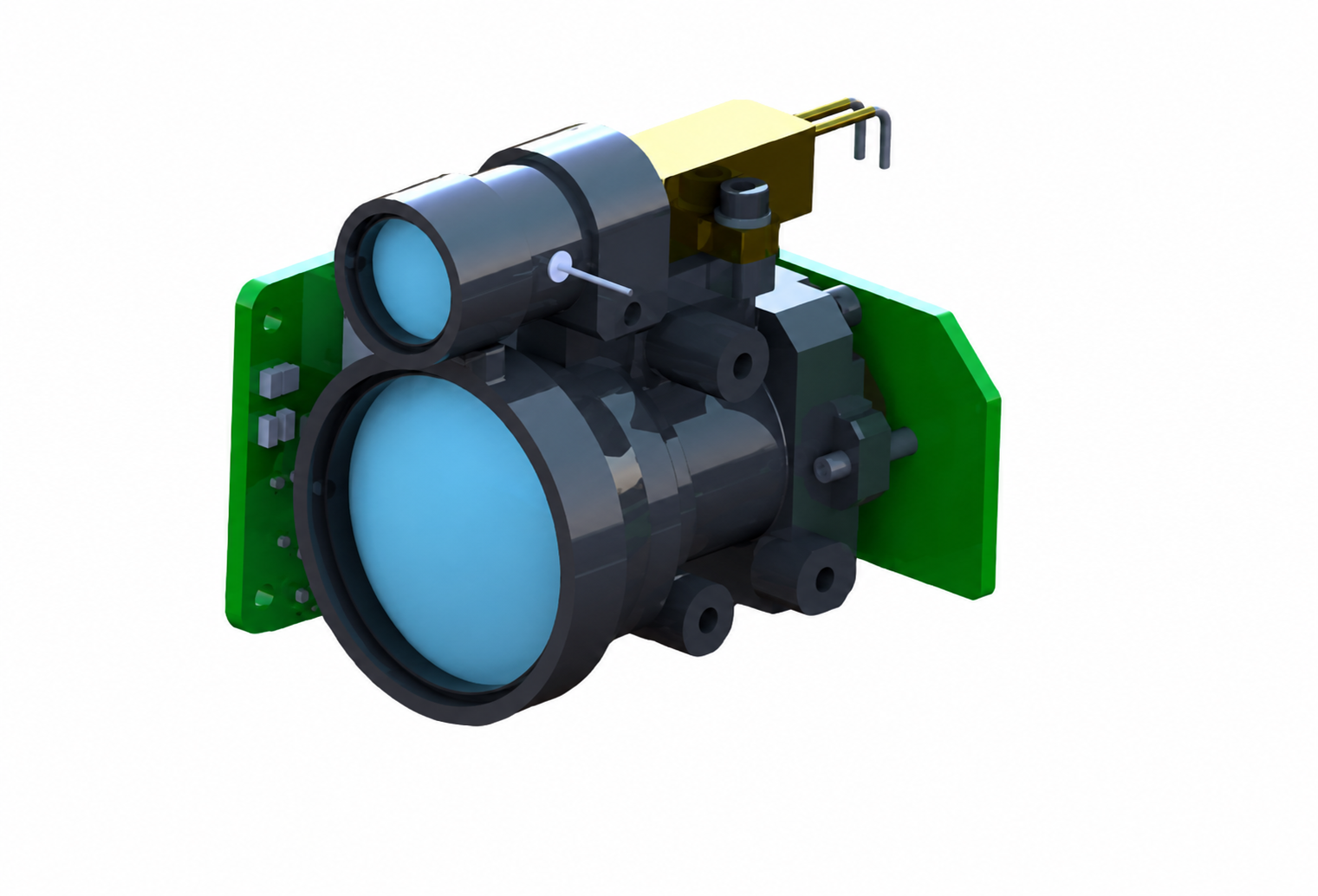
Huanxin Measurement & Control Technology Co., Ltd. develops and manufactures high-performance Laser Rangefinder Modules built specifically for integration into electro-optical pods, mobile defense platforms, and static air-defense installations.
Our lightweight 1535nm series provides system integrators with:
Compact SWaP Architectures: Low-weight modules starting under 50g, purpose-engineered for multi-rotor interceptors and compact gimbal pods.
Extended Reach: Ranging modules rated from 3,000 m up to 20,000 m, accommodating everything from short-range perimeter shields to heavy fixed-wing C-UAS radar cueing.
Tailored Configuration: Direct OEM engineering support for custom structural brackets, connector types, baud rates, and specific beam divergence profiles.
Explore our engineering catalog and module specs directly at laserrangefinder.cc.
Building Reliable Low-Altitude Air Defense
The effectiveness of any counter-drone setup depends on target acquisition speed and spatial accuracy. By integrating a rugged, high-frequency 1535nm eye-safe ranging sensor into your electro-optical package, your system moves beyond simple target detection to deliver real-time, fire-control-grade coordinate tracking.
Frequently Asked Questions
Why is 1535nm preferred over 905nm for C-UAS payloads? 905nm diodes are limited by eye-safety limits and atmospheric backscatter, restricting practical drone detection to very short distances. In contrast, 1535nm lasers emit high-energy pulses that remain Class 1 eye-safe, giving operators the optical power needed to acquire small targets kilometers away without risking retinal injury to personnel on the ground.
How does laser repetition rate impact target tracking for fast drones? A low rate (such as 1 Hz) provides position updates every second, leaving wide gaps in telemetry if a drone is accelerating or dodging. A 5 Hz to 20 Hz repetition rate delivers a steady stream of distance markers, allowing tracking algorithms to calculate smooth acceleration vectors, predict future flight paths, and cue jammers or interceptors with minimal delay.
Can a 1535nm laser rangefinder work through rain, fog, and dust? Yes. Light in the 1535nm band experiences lower Rayleigh and Mie scattering than shorter visible and near-infrared bands. Combined with digital signal processors capable of multi-echo filtering, the sensor strips out early scatter from precipitation and isolates the return echo from the solid target.
What beam divergence is recommended when tracking Class 1 and Class 2 UAS? Narrow beam divergence is essential for small cross sections. A beam spread between 0.3 mrad and 0.6 mrad keeps the optical energy concentrated on the vehicle body at extended ranges, avoiding energy spill and background noise.
Can Huanxin adjust laser rangefinder hardware for custom turret housings? Yes. Huanxin Measurement & Control Technology specializes in OEM design services. We provide custom optical alignment brackets, modified chassis dimensions, tailored connector interfaces, and adapted serial protocols to match your exact electrical and structural gimbal specifications.