A thermal camera may show a vessel clearly while the laser rangefinder beside it struggles to report a stable distance. This is common at sea. Sunlight reflects from moving waves, spray creates unwanted returns, and humid air weakens the signal before it reaches the target.
For engineers building maritime electro-optical/infrared (EO/IR) systems, the challenge is not simply finding a laser that reaches farther. The rangefinder must work with the camera, remain aligned on a moving platform, and deliver useful measurements under changing coastal conditions.
Compact 1535nm laser rangefinder modules are one option for this work. They can offer a practical balance of range, size, and laser-safety design, but their performance still depends on the optics, signal processing, enclosure, and operating environment.
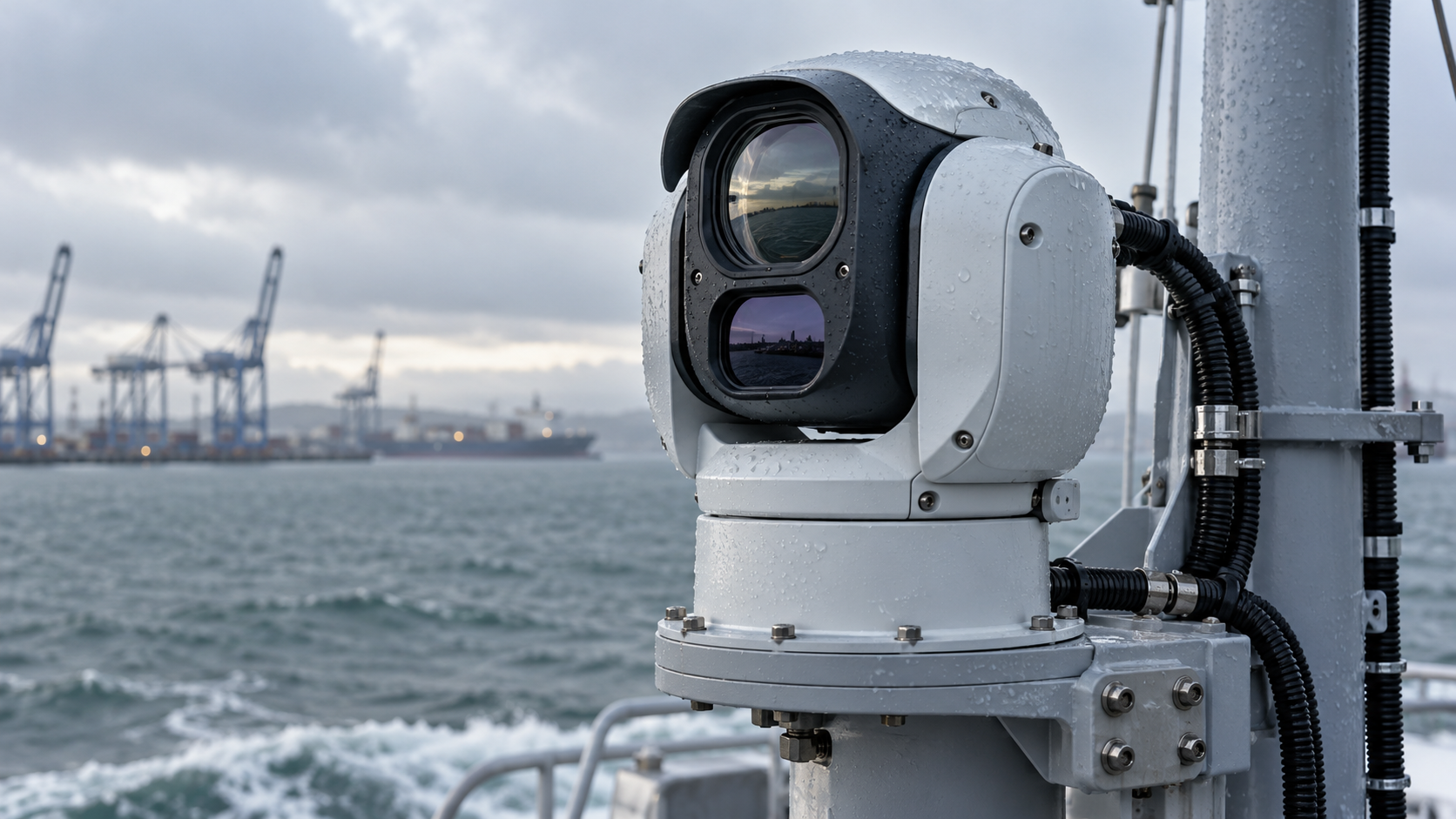
Why Laser Ranging Is Difficult at Sea
Three conditions account for many unreliable distance readings in maritime applications.
Sun Glint and Reflections from Waves
At low sun angles, individual wave faces reflect bright flashes toward an EO/IR turret. That background light can reduce the receiver's ability to distinguish a brief laser return from optical noise.
Waves also create false distance measurements. If part of the outgoing beam touches a nearby wave crest, the reflected pulse can arrive before the return from the vessel being observed. A receiver that accepts the first signal above its detection threshold may report the distance to the water instead of the intended target.
Fog, Haze, and Sea Spray
Coastal air often contains salt particles, moisture, and suspended droplets. These particles scatter and absorb light. A laser pulse becomes weaker as it travels outward, and the reflected signal loses more energy on its way back.
Fog is especially demanding because its droplets can be similar in size to near-infrared wavelengths. The amount of attenuation depends on visibility, droplet distribution, wavelength, and atmospheric conditions. A longer wavelength is not a guarantee of better performance in every type of fog.
Motion and Alignment
A rangefinder fitted inside a stabilized gimbal shares the platform with thermal and visible-light cameras. Vibration, wave impact, mechanical stress, and temperature changes can alter the relationship between their optical axes.
Even when the rangefinder itself functions normally, a small alignment error can cause a narrow laser beam to miss a distant target. Mechanical stability and repeatable boresight calibration therefore matter as much as the advertised ranging distance.
What Makes 1535nm Useful for Maritime EO/IR?
The main attraction of 1535nm is its combination of compact pulsed-laser technology and favorable eye-safety characteristics compared with shorter near-infrared wavelengths. It is widely associated with erbium-glass laser sources used in OEM rangefinding modules.
Light near 1535nm is absorbed more strongly in the front structures of the eye than 905nm or 1064nm light, reducing the potential for retinal exposure. However, wavelength alone does not make a complete device Class 1 or Class 1M. The classification depends on the accessible emission, optical design, operating modes, and testing under IEC 60825-1.
The differences between common ranging wavelengths are worth considering early in the design process.
Does 1535nm Penetrate Sea Fog Better?
It can perform well in some haze and light-fog conditions, but claims that 1535nm consistently “cuts through” dense fog are misleading. Studies of wavelength-dependent extinction in fog and haze show that attenuation changes with particle size and weather conditions. In some fogs, the difference between near-infrared wavelengths is modest.
For a maritime system, the practical question is whether the complete transmitter–receiver design maintains enough signal-to-noise ratio at the required distance. Test results should identify visibility, target reflectivity, target size, and measurement criteria. A clear-weather range rating should never be treated as a guaranteed range in heavy fog.
Reducing False Returns from Water Glint
Changing wavelengths is only part of the solution. Receiver design and signal processing often make the biggest difference when the sea surface produces unwanted reflections.
Distance Gating and Multiple Returns
Time gating tells the receiver to ignore returns arriving within a selected interval after each laser pulse. For example, if the intended vessel is well beyond nearby spray and wave crests, a properly chosen minimum-distance gate can prevent those close reflections from being accepted as the target.
This method has a trade-off: a gate that is too aggressive can also discard a legitimate close target. It should be adjustable for the mission and the available sightline.
Where supported, multi-return detection helps the system distinguish an early reflection from the water from a later reflection off a vessel. Instead of relying on the first detected pulse, the processor can evaluate several return candidates. Adaptive detection thresholds may also help when background light varies quickly.
These capabilities are not automatic features of every 1535nm module. Integrators should confirm which functions are provided by the rangefinder and which must be implemented in the host processor.
Optical Filtering and Receiver Design
A narrowband optical filter centered on the laser wavelength can reject much of the broadband sunlight entering the receiver. Appropriate aperture design, baffling, detector selection, and gain control provide additional protection against glare.
Polarization filtering can sometimes reduce reflected background light, although its effectiveness depends on the sea surface, viewing angle, and polarization of the useful return. It should be evaluated experimentally rather than assumed to work in every installation.
In practice, reliable maritime ranging usually comes from several smaller improvements working together: good optical alignment, reduced stray light, suitable detection logic, and careful target selection.
Integrating a 1535nm Laser Rangefinder into a Marine Gimbal
Successful integration starts with the whole payload, not just the laser module's dimensions.
Maintain Boresight Alignment
The laser transmitter, receiver, thermal camera, and visible-light camera should be aligned to a common reference. Engineers need to account for mounting tolerances, thermal expansion, and movement under vibration.
For narrow beams, small angular errors become significant over several kilometers. A rigid mounting structure, stable fasteners, and a repeatable calibration procedure help keep the range measurement on the object shown in the video feed.
The optical window must also be included in the design review. Its material, coatings, tilt, and surface contamination can affect laser transmission and introduce unwanted reflections.
Protect the Payload from Salt and Moisture
Marine equipment faces corrosion, condensation, rain, and salt spray. The outer EO/IR housing should be selected and tested for the conditions it will actually encounter.
An IP67-rated enclosure provides a defined level of dust and temporary water-immersion protection, but IP67 alone does not establish long-term resistance to salt corrosion. Depending on the installation, engineers may also need corrosion-resistant materials, appropriate sealing, protected electronics, and environmental testing.
Dry-gas purging or other moisture-control methods can help prevent condensation inside an optical cavity. Confirm whether these measures apply to the individual rangefinder module, the finished gimbal, or both; protection of one component does not automatically protect the full assembly.
Choose the Right Communication Interface
Many OEM rangefinders offer TTL serial communication or RS-422, with availability depending on the model.
TTL is generally convenient for short connections to a nearby processor inside a compact payload.
RS-422 uses differential signaling and can provide better noise immunity over longer cable runs or around motors and switching electronics.
Before selecting an interface, check supply voltage, connector pinout, cable routing, command protocol, update frequency, and whether external triggering is required. Those details can be as important to integration time as the module's optical specifications.
Choosing a Huanxin 1535nm Module for Maritime Applications
Huanxin Measurement & Control Technology Co., Ltd. offers OEM 1535nm laser rangefinder modules across several nominal distance classes. This range allows designers to balance payload weight with the measurement distance their platform needs.
The following figures summarize the manufacturer's published product categories. They are not measured maritime ranges; actual results depend on the target and atmospheric conditions.
The appropriate choice depends on more than the longest number in the table. For example, Huanxin's published 20 km specification applies to a large building-type target under stated visibility and reflectivity conditions; its published vehicle-target figure is different. Likewise, a small, low-reflectivity object on rough water may be harder to range than a large test target in clear air.
For an OEM project, request the model-specific datasheet and confirm target assumptions, minimum range, accuracy, pulse rate, beam divergence, power consumption, electrical interface, and environmental test evidence before finalizing the design.
Where Maritime Laser Ranging Adds Value
A rangefinder makes a visual or thermal observation more useful by adding distance information. Paired with known platform position and line-of-sight direction, that measurement can contribute to target localization and tracking.
Harbor and coastal observation. EO/IR cameras can help operators inspect small craft that are difficult to identify on wide-area sensors. Distance measurements add context to the video image and support consistent observation as traffic moves through a channel.
Search and rescue. A thermal sensor may detect a small heat signature near the waterline. A range measurement can help the crew estimate how far away the contact is, provided there is enough visibility and a usable return from the target. It does not, by itself, establish a precise geographic position.
Uncrewed surface and aerial platforms. Compact modules can add distance measurements to weight-constrained payloads. Designers must balance range performance against mass, power demand, heat dissipation, vibration, and available mounting space.
Across all three uses, it is sensible to treat laser ranging as one input in a wider sensor system. Radar, optical imagery, inertial data, and operator judgment remain valuable when the weather prevents a reliable laser return.
A Practical Checklist Before Selecting a Module
Before ordering a 1535nm rangefinder for a marine EO/IR project, define the operating conditions as clearly as possible:
Target: What size, shape, and reflectivity must the system measure?
Environment: What visibility, humidity, spray, and sea-state conditions are expected?
Performance: What range, accuracy, minimum distance, and measurement frequency are actually needed?
Integration: What are the payload's limits for mass, dimensions, power, heat, and electrical interfaces?
Optics: Can the laser share the available aperture and window without unacceptable reflections or alignment error?
Validation: What evidence is available for laser safety, vibration, sealing, corrosion resistance, and field performance?
A short test with the real target and payload often reveals limitations that a headline range specification cannot show.
Frequently Asked Questions
Is a 1535nm laser rangefinder eye-safe?
The wavelength is favorable for reducing retinal exposure compared with 905nm and 1064nm designs. Nevertheless, the finished product must be evaluated and classified under the applicable laser-safety standard. Do not assume Class 1 status solely from the wavelength.
Can a 1535nm rangefinder work in heavy sea fog?
Dense fog can severely attenuate laser light at 1535nm, just as it can at other optical wavelengths. Performance in haze or light fog depends on the complete system and the local weather. Ask for test conditions rather than a general fog-penetration claim.
How can a system avoid measuring nearby waves instead of a vessel?
Configurable distance gates can reject close returns, while multi-return processing can help identify a later echo from the vessel. Optical filtering, receiver settings, and proper aiming also help. The available features depend on the chosen module and host electronics.
Does an IP67 rangefinder automatically make the entire EO/IR gimbal marine-grade?
No. The finished housing, connectors, windows, and moving interfaces need their own environmental assessment. Salt resistance and long-term condensation control require attention beyond the IP67 rating.
What matters most when comparing 3 km and 20 km modules?
Start with the target and working conditions, then compare weight, power, beam divergence, measurement frequency, minimum range, interfaces, and evidence behind the range claim. A longer nominal range is worthwhile only if the platform can support the module and the mission needs it.
Final Thoughts
Maritime laser ranging is a system-level engineering problem. The right wavelength helps, but stable measurements also require control of water reflections, sensible signal processing, careful optical alignment, and protection from the marine environment.
For teams developing custom EO/IR payloads, Huanxin's 1535nm rangefinder family offers several size and distance options for OEM integration. The best starting point is a clear definition of the target, sea conditions, and payload constraints—followed by tests that reflect how the equipment will actually be used.