TTL vs RS-422 for Laser Rangefinder Module Integration
A laser rangefinder can work perfectly on a workbench and still become troublesome once it is installed inside a vehicle, EO payload, handheld optic, or larger electro-optical system. Quite often, the rangefinder itself is not the issue. The weak point is the cable between the module and the host controller.
That is where TTL and RS-422 matter.
TTL is simple and convenient when the laser rangefinder sits close to the processor. RS-422 is usually a better fit when the cable becomes longer, passes through several connectors, or runs near motors and switching power electronics.
Huanxin Measurement & Control Technology Co., Ltd. manufactures 1535 nm laser rangefinder modules for OEM integration, with ranging classes from 3 km to 20 km. Communication, connector, electrical, mechanical, and optical requirements can vary from one project to another, so the serial link should be chosen as part of the whole installation.
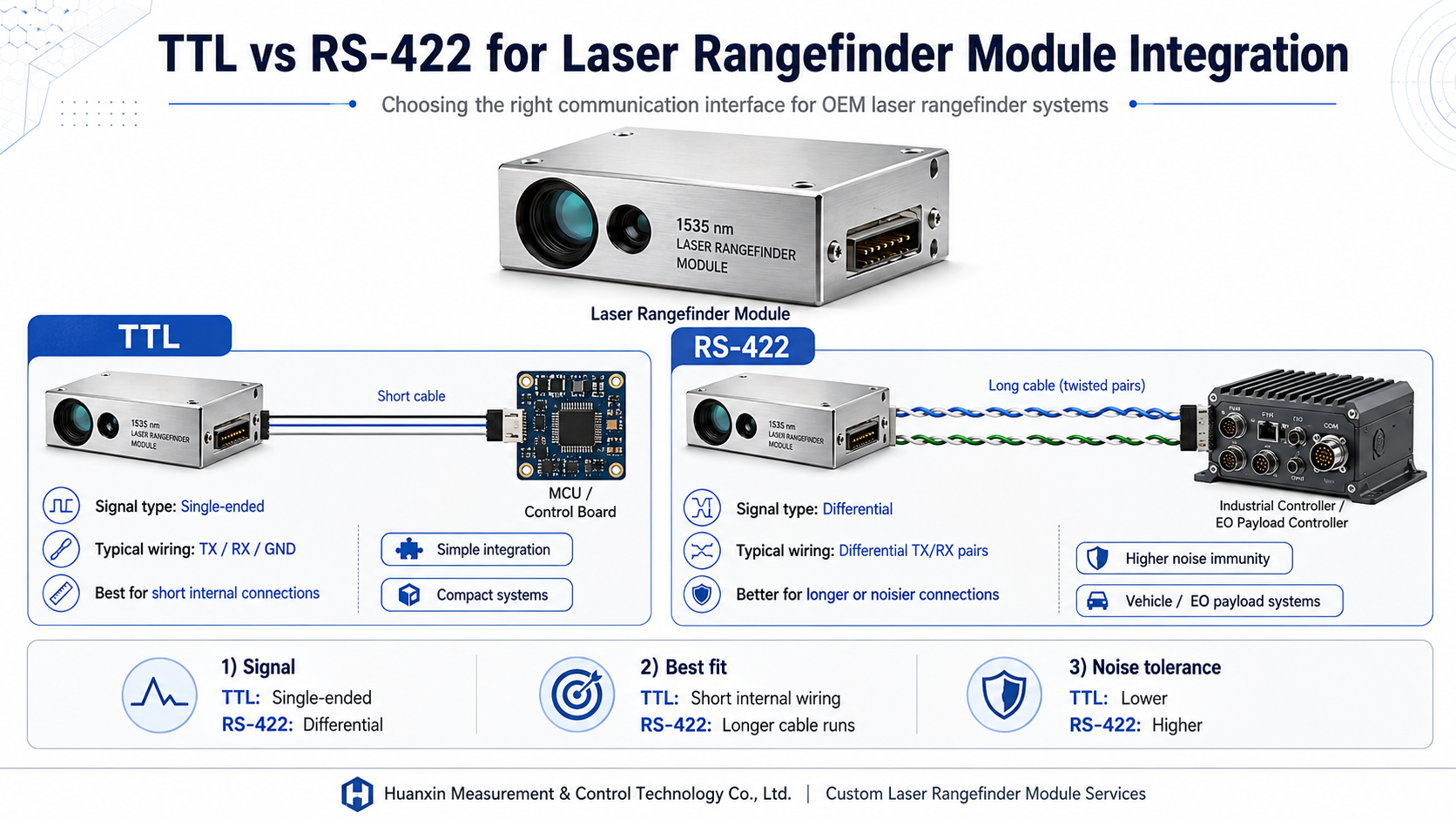
Laser Rangefinder TTL vs RS422: What Really Changes?
The main difference is the way the electrical signal travels through the cable.
TTL serial communication is normally single-ended. The receiver reads a signal voltage against a ground reference. The wiring is simple, which is useful when the module and control board are mounted close together.
RS-422 uses differential signaling. Each channel travels through a pair of conductors, and the receiver reads the voltage difference between the two wires. Electrical noise that reaches both wires in a similar way is easier for the receiver to ignore.
That sounds like a small detail, but it changes where each interface feels comfortable.
Laser Rangefinder TTL vs RS422 Inside an OEM System
Take a compact handheld unit. The rangefinder may sit only a few centimeters from the main board, share the same local power supply, and use a short internal harness. TTL is often the cleanest choice.
Now picture a stabilized optical head on a vehicle. The laser rangefinder sits near the optical axis while the main controller is farther back. The cable passes close to a gimbal motor, DC-DC converter, heater wiring, and several connectors. RS-422 starts to earn its extra hardware.
The interface name alone is not enough. Cable route, host voltage, grounding, and nearby electronics all matter.
The Serial Commands May Stay the Same
Electrical signaling and command packets are not the same thing.
A host can send a ranging command and receive distance data through either electrical link if both sides use matching serial settings and packet definitions.
Think of it like sending the same message over two different phone lines. The words can stay the same even though the line itself changes.
TTL Laser Rangefinder Module: Where TTL Fits Best
A TTL laser rangefinder module is a natural fit for short internal wiring. It is compact, easy to connect, and often works directly with an embedded processor when the voltage levels match.
This is common in handheld optics, compact EO payloads, small observation devices, and tightly packed optical assemblies.
TTL can also reduce PCB parts. If no level conversion is needed, the host may communicate through its UART without adding a differential transceiver.
TTL Laser Rangefinder Module Wiring for Short Runs
A basic TTL link usually needs TX, RX, and ground.
Host TX goes to rangefinder RX. Host RX goes to rangefinder TX. Both sides also need a suitable ground reference.
Keep the signal lines short and avoid routing them beside motor leads, high-current traces, or switching power cables. Inside a compact enclosure, sensible routing can make TTL very dependable.
Check Logic Voltage Before You Connect It
“TTL” does not automatically mean every port uses the same voltage.
One host may use 3.3 V I/O while another uses 5 V. Before connecting the two devices directly, confirm the rangefinder TX level, rangefinder RX threshold, and the safe input range of the host processor.
If the levels do not match, a level shifter is usually a much cleaner fix than hoping the pins will tolerate each other.
RS422 Laser Rangefinder: Why Differential Signaling Helps
An RS422 laser rangefinder becomes attractive when the cable is longer or the surrounding electronics are noisy.
Vehicles, moving optical platforms, industrial equipment, and larger EO systems can contain motors, fans, switching regulators, heaters, slip rings, and long power runs. A single-ended serial line has to live in that same electrical space.
RS-422 sends each channel through a differential pair. With suitable twisted-pair cable, the two wires tend to pick up similar external noise. The receiver cares mainly about the difference between the pair, giving the link more margin.
RS422 Laser Rangefinder for Vehicle and EO Payload Wiring
Large platforms rarely keep every electronic board in one place.
The rangefinder may be in the front optical section, while the main processor sits behind stabilization electronics or a power board. The cable may pass through several connectors or a moving harness.
RS-422 is well suited to that layout. It is especially useful when a clean ground reference cannot be assumed at every point along the cable.
Long Cable Does Not Mean Unlimited Cable
RS-422 is often associated with long cable runs, but there is no universal maximum length for every installation.
Baud rate, cable construction, termination, connector quality, routing, ground offset, and surrounding electrical noise all change the usable distance.
A slower serial link on a good twisted pair can usually travel farther than a faster link on poor wiring. Treat cable length as an engineering choice tied to the real equipment.
TTL vs RS422 Distance: How Far Should the Cable Run?
People searching TTL vs RS422 distance often want one simple number. In practice, a fixed meter value can create the wrong expectation.
TTL is strongest when the controller is close to the rangefinder. Think short internal harness rather than a cable routed through a whole platform.
RS-422 becomes more attractive as the cable gets longer, moves through connectors, crosses between electronic sections, or runs beside motors and power electronics.
TTL vs RS422 Distance Depends on More Than Cable Length
A one-meter cable inside a quiet enclosure is not the same as a one-meter cable routed beside a motor driver.
Cable type matters too. Twisted pair, shielding, connector transitions, conductor size, and routing all affect signal quality. Baud rate changes the available margin as well.
When speaking with a rangefinder supplier, send both the expected cable length and a short description of where the cable will run.
A Useful Rule for Integration Engineers
Use TTL when the laser rangefinder and controller share one compact, clean electronics area.
Move toward RS-422 when the link leaves that area, passes through moving joints, crosses between enclosures, or sits close to noisy power electronics.
That simple rule is more useful than treating one cable length as a hard boundary.
LRF Communication Interface: What the Host Needs
An LRF communication interface is more than a connector label. The host needs matching voltage levels, serial settings, wiring direction, and packet handling.
Before the first power-up, confirm these items:
LRF Communication Interface Settings Worth Confirming Early
A one-page interface sheet can save a surprising amount of time.
Record the connector pin numbers, signal names, voltage levels, baud rate, packet length, response timing, and power input. For RS-422, clearly mark the two conductors in each differential pair.
Small mistakes are common: TX and RX are reversed, pair polarity is swapped, the baud rate is wrong, or the host expects a different voltage level.
RS-422 and RS-485 Are Not the Same Port
RS-422 and RS-485 both use differential signaling, so they are sometimes treated as interchangeable terms.
They are not identical standards. If the host uses an RS-485 transceiver, confirm that its electrical configuration and direction control can communicate correctly with the selected laser rangefinder.
Do not rely only on A/B labels or connector shape.
Laser Rangefinder TTL vs RS422 for Moving Platforms
Moving platforms bring cable flex, rotating joints, motor current, switching power supplies, and tight harness routing into the same space.
RS-422 is often the safer choice for vehicle-mounted systems and larger EO equipment because it gives the serial link more electrical margin.
TTL still works well inside a local optical head when the controller is close to the rangefinder.
When TTL Is the Cleaner Choice
More hardware is not automatically better.
If the rangefinder sits beside the processor, adding differential transceivers may consume PCB area, connector pins, power, and assembly space without bringing much practical value.
Compact payloads often care about every gram and every millimeter. For a short, clean connection, TTL can be the more elegant answer.
When RS-422 Earns the Extra Hardware
RS-422 becomes worthwhile when the cable leaves one enclosure, passes through moving sections, runs across a larger platform, or sits close to high-current electronics.
It can also make sense when the equipment may be expanded later. Extra communication margin is easier to build in early than to add after the control board and harness are already fixed.
Plan Power and Communication Together
The serial cable does not operate by itself. The laser rangefinder also needs a suitable DC supply, and the power wiring may follow the same route.
Huanxin's 1535 nm product family includes compact short-range units and larger long-range units with different power requirements. The 3K-193, for instance, uses 5 V input and has dimensions of 48.5 × 36 × 26 mm with a weight of no more than 60 g.
Longer-range units use different supply ranges, so the communication and power wiring should be planned around the exact unit chosen for the project.
Keep High-Current Wiring Away from Serial Lines
Motor leads, heaters, switching converters, and high-current return paths can inject unwanted noise into nearby wiring.
With RS-422, keep each differential pair together and use suitable twisted-pair cable. With TTL, pay close attention to the ground path because voltage drop in the shared return can shift the logic reference.
Good routing costs almost nothing during layout work. Finding an intermittent communication fault after assembly is much more painful.
Choosing TTL or RS-422 for Huanxin Laser Rangefinder Modules
Huanxin Measurement & Control Technology Co., Ltd. manufactures 1535 nm laser rangefinder modules in 3 km, 4 km, 6 km, 8 km, 12 km, 18 km, and 20 km ranging classes.
The modules are intended for OEM use in EO payloads, handheld optics, vehicle-mounted systems, electro-optical observation equipment, and custom optoelectronic assemblies.
The 3K-193 provides TTL and RS-422 communication options. Huanxin can also discuss customized connector, electrical, mechanical, optical, and communication requirements when a standard configuration does not fit the host equipment.
What to Send Before Requesting Interface Customization
The quickest way to choose a suitable interface is to share the real installation conditions.
A Simple Choice for Most OEM Projects
If the rangefinder sits next to the host processor inside one compact enclosure, start with TTL.
If the cable is longer, crosses different sections of the equipment, passes near motors, or runs through a moving platform, start with RS-422.
If neither choice is obvious, share the host layout and cable route with Huanxin before the PCB and harness are fixed. A short discussion at this stage can prevent a long debugging session later.
Choosing the Right Interface for Your System
The best interface is not the one with the strongest specification on paper. It is the one that fits the real installation.
TTL keeps short internal connections simple, light, and easy to integrate. RS-422 gives longer and noisier cable runs more electrical margin. Choose the serial link together with cable routing, host voltage, power, connector layout, and nearby electronics. When those pieces are considered together, communication becomes a clean part of the finished product instead of something that has to be repaired late in the project.
Frequently Asked Questions
Can a TTL laser rangefinder module connect directly to a 3.3 V MCU?
Sometimes. Confirm the rangefinder TX output level, RX input threshold, and the safe input range of the MCU. If the voltage levels do not match, use a suitable level shifter.
Is an RS422 laser rangefinder always better than TTL?
No. RS-422 is stronger for longer or noisier wiring, while TTL is often simpler for short internal links. The physical installation should drive the choice.
What cable works well with an RS-422 laser rangefinder?
Use a suitable twisted pair for each differential channel and keep the pair together through the harness and connectors. Shielding may help in electrically noisy equipment when it fits the grounding arrangement.
Can TTL and RS-422 use the same ranging commands?
Yes. The electrical signaling can change while the command packets remain the same, as long as both ends use matching serial settings.
What should I send Huanxin before choosing an LRF communication interface?
Send the cable length, host voltage, preferred connector, baud rate, available power, platform type, nearby noise sources, mechanical limits, and required ranging class. Huanxin can then match the communication link more closely to the OEM installation.