Switch on your high beams during a midnight cloudburst, and you immediately see the problem: an opaque wall of white glare right in your windshield. Photons strike airborne raindrops, scatter off at wild angles, and bounce straight back into your eyes before illuminating anything down the road.
Laser rangefinders face this exact physical wall in degraded visual environments. Point an entry-level rangefinder into thick sea spray, heavy rain, or blowing sand, and the sensor trips immediately. It catches the first splash of reflected light off nearby particles and reports a target distance of eight meters—even though your actual objective sits three kilometers out across the valley.
For defense pods, border tracking cameras, maritime gimbals, and remote survey stations, blind spots caused by a passing rain squall are unacceptable. Modern optical systems solve this by combining three core techniques: temporal filtering, digital echo discrimination, and longer wavelengths that slip cleanly through suspended particles.
Atmospheric Scatter and Sensor Saturation
Airborne moisture and fine sand do not form a single flat surface. They create distributed backscatter along the entire path of a laser pulse.
Each tiny droplet or silt particle absorbs a fraction of the beam's energy and deflects the rest. The sensor's receiver—typically an avalanche photodiode—sees a wide, noisy surge of returned energy within the first few hundred nanoseconds of flight time.
Early-generation systems relied on simple analog comparators. The moment incoming light crossed a fixed voltage threshold, internal timing clocks stopped. When mist or dust generated enough aggregate bounce to trip that threshold, the system logged a false reading. In heavy fog, traditional units fail to track real targets, returning erratic values or locking up entirely.
Range Gating: Blocking Foreground Glare
Before digital signal processors parse a return waveform, the optical receiver can physically ignore near-field clutter using range gating.
Range gating operates as a high-speed temporal shutter. Light moves through air at roughly 30 centimeters per nanosecond. Because that speed is constant, the time required for a pulse to reach a specific distance and return is predictable down to fractions of a nanosecond:
If an operator knows the target zone lies beyond 600 meters, there is no reason to collect photons between 0 and 599 meters. By holding the detector in an off or suppressed state for the first four microseconds, the system lets the outgoing pulse travel past local rain sheets, vehicle glass, or dust clouds before opening the receiver gate.
This gating mechanism is critical when firing a laser through vehicle windshields, marine bridge windows, or camouflaged mesh netting. Without range gating, the front surface of dirty glass creates an massive reflection that saturates the receiver instantly. A narrow range gate lets the light clear the windshield before the sensor begins listening for reflections.
Multi-Echo Discrimination: Isolating the Real Target
Range gating removes near-field interference, but it cannot eliminate suspended particles mixed in around the target itself. That is where multi-echo laser rangefinder architectures take over.
Instead of shutting down after detecting a single burst of light, a multi-echo receiver digitizes the entire returning waveform. When a pulse strikes multiple objects along its path, the sensor records each reflection as an individual energy peak.
First Pulse vs. Last Pulse Logic
Switching between first-pulse and last-pulse modes determines which peak the digital signal processor uses to calculate range:
First-pulse mode latches onto the leading edge of the earliest return. This is useful for spotting overhead power lines against a clear sky or detecting netting draped over hidden positions.
Last-pulse mode discards all early returns and calculates range from the final reflection spike. Because a solid steel hull or masonry building reflects photons far more efficiently than rain droplets or thin leaves, the final spike represents the true background target.
1535nm vs. 905nm and 1064nm Wavelengths
Wavelength selection directly impacts how well a rangefinder cuts through dirty air. While consumer units frequently use 905nm diode lasers and older military hardware runs on 1064nm, modern field systems favor 1535nm Erbium-glass emitters.
article Scattering Dynamics
When airborne droplets have radii comparable to the laser's wavelength, Mie scattering disperses the beam. The 1535nm band is longer than typical 905nm signals, allowing it to slip past fine mists and smoke particles with less attenuation.
Furthermore, because light at 1535nm is absorbed by the eye's cornea and lens before reaching the retina, systems can fire pulses with substantially higher peak output power while remaining eye-safe. More power into the atmosphere means a stronger return signal punches back through the storm.
Integrating Custom Modules for Real-World Deployments
Standard catalog modules rarely suit custom electro-optical turrets or compact reconnaissance gear. Varying gimbal payload limits, power buses, and hostile operating temperatures demand targeted hardware integration.
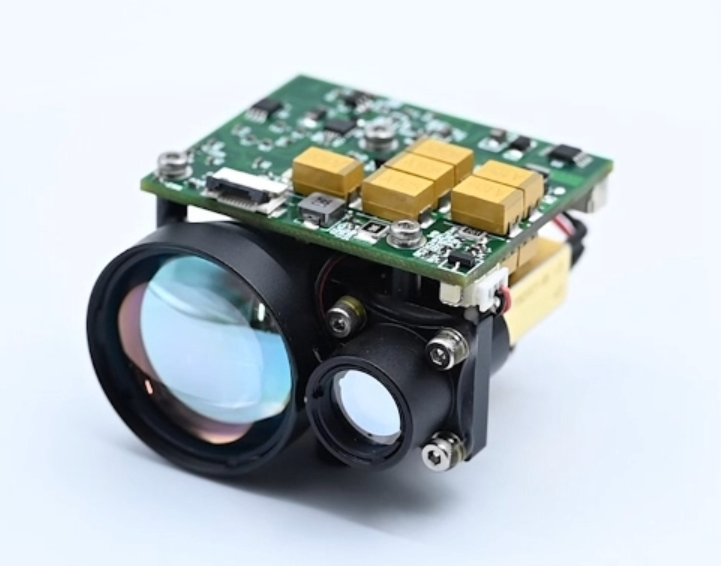
At Huanxin Measurement & Control Technology Co., Ltd., we design and manufacture high-precision laser rangefinder modules engineered around harsh field conditions. By pairing compact 1535nm Erbium-glass sources with proprietary multi-echo waveform algorithms and dynamic range-gating registers, our assemblies maintain repeatable accuracy from arctic cold to desert sandstorms.
Our engineering team works directly with global system integrators to configure:
Customized mechanical housings and optical aperture dimensions
Flexible communication interfaces, including TTL, RS-232, and RS-422
Tailored range-gating look-up tables matched to application envelopes
Embedded firmware for real-time multi-echo peak selection
Frequently Asked Questions
Does range gating introduce latency into distance readouts?
No. Because light travels roughly 300,000 kilometers per second, delaying sensor activation by several microseconds creates no perceptible lag. Modules maintain their standard real-time output frequencies, typically between 1 Hz and 20 Hz.
How does last-pulse logic pick up a target behind heavy camouflage netting?
Camouflage netting has small openings between woven strands. While part of the beam reflects off the exterior weave (creating an initial echo), remaining photons pass through the gaps, strike the hard object behind it, and bounce back as a distinct final echo.
Can a 1535nm laser rangefinder penetrate dense sea fog?
While dense fog attenuates all optical signals eventually, 1535nm light suffers far less scattering than 905nm or visible wavelengths. Combined with multi-echo discrimination and high peak pulse power, 1535nm systems provide usable range readings where legacy optics fail completely.
Can range gating be adjusted dynamically in the field?
Yes. Through standard serial commands (such as RS-422 or TTL), host platforms can change the minimum gate distance in real time based on changing weather conditions or known standoff distances.
What power requirements do compact 1535nm OEM modules typically have?
Modern 1535nm modules run on low-voltage DC inputs (typically 3.3V to 5V). Because the laser operates in micro-pulses rather than continuous wave, standby power consumption stays low, making them suitable for battery-operated handheld optics and compact drone payloads.