Picking an optical ranging sensor feels a bit like buying a telescope or a camera lens—every extra kilometer on the spec sheet sounds tempting until you look at the weight, power budget, and price tag. When your engineering team sits down to spec an electro-optical gimbal, a handheld thermal monocular, or a mast-mounted border camera, you almost always land in the mid-range sweet spot between three and eight kilometers.
Why does this specific bracket cause so many headaches for hardware integrators? Because jumping from 3,000 meters to 8,000 meters isn't just a software tweak. It changes the physical glass inside the receiver, shifts your center of gravity inside a stabilized turret, and alters how your battery pack handles peak current spikes. At Huanxin Measurement & Control Technology Co., Ltd., we work alongside system engineers every single day who are trying to balance distance against payload limits. Let's pull back the curtain on how these four distance tiers actually behave outside a sterile lab.
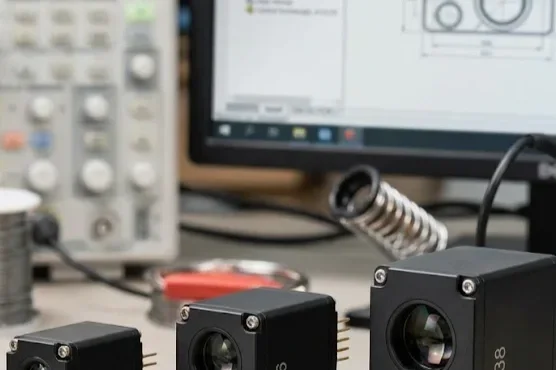
Why Mid-Range 1535nm Optics Dominate Modern Optoelectronics
If you spent time working with legacy 905nm semiconductor diodes a decade ago, you probably remember their biggest flaw: they hit a wall right around one or two kilometers before running into strict eye-safety power limits. To push light out to three, four, six, or eight kilometers without risking retinal damage to people downrange, the
industry standardized around 1535nm erbium-glass microchip lasers.
The Physics Behind Eye-Safe Erbium-Glass Emitters
Why does 1535nm light work so well for an OEM laser rangefinder? Your eye's cornea and lens absorb light at this wavelength before it ever reaches the retina. That simple biological quirk lets engineers pump dramatically higher peak pulse energy into the sky while keeping a Class 1 eye-safe rating.
Higher pulse energy translates directly into cleaner return echoes. Instead of squinting to hear a whisper of reflected photons over background solar noise, the avalanche photodiode (APD) inside a 1535nm receiver gets a crisp, unmistakable pulse. Even better, 1535nm light slices through light haze, battlefield smoke, and coastal humidity far more effectively than shorter near-infrared wavelengths.
Real-World Atmospheric Attenuation vs. Datasheet Numbers
Here is a secret every seasoned optical engineer knows: a datasheet rating is a best-case baseline, not a magic guarantee in a rainstorm. When we rate a sensor at 3km, 4km, 6km, or 8km, those numbers assume standard atmospheric visibility (typically 10 to 15 kilometers), relative humidity under 80%, and a standard NATO vehicular target measuring 2.3 meters by 2.3 meters with 20% to 30% reflectivity.
Drop that same sensor into a humid coastal morning with 5km visibility, and your effective ranging distance shrinks fast. That is why buying a 6km unit when your mission profile strictly calls for 3.5km of reliable ranging is smart engineering—you are buying atmospheric margin, not just raw distance.
How to Choose Mid Range Laser Rangefinder Module Hardware
Figuring out how to choose mid range laser rangefinder module hardware comes down to respecting the laws of physics. Photons spread out as they travel, and returning light drops off according to the inverse-square law—meaning doubling your distance requires roughly sixteen times more optical link budget to get the exact same signal back.
Size, Weight, and Power (SWaP) Trade-Offs Across Distance Tiers
You cannot cheat optics. To catch faint photons bouncing back from eight kilometers away, you need a wider receiver lens and a higher-energy laser resonator. Naturally, bigger glass and beefier pump diodes add grams and millimeters.
Across our product lineup at Huanxin, you can see that physical progression clearly:
- 3km Tier (3K-193): Weighs ≤60 g with a tiny 48.5 × 36 × 26 mm footprint.
- 4km Tier (4K-254): Steps up to ≤75 g and roughly 55 × 34 × 45 mm to house larger receiving optics.
- 6km Tier (6K-256): Holds steady at ≤75 g while optimizing pulse efficiency and continuous thermal handling.
- 8km Tier (8K-338): Moves up to ≤100 g to accommodate an enlarged receiving aperture and ultra-tight beam collimation.
Power Draw, Thermal Dissipation, and Duty Cycles
Have you ever watched a compact rangefinder throttle itself halfway through a tracking run? Continuous firing at 10 Hz generates real heat inside the erbium-glass cavity. While standby power across all four tiers hovers quietly around 1.2 W to 1.5 W, peak firing spikes tell a different story.
Our 4K-254 draws around 3.5 W rated and up to 7 W at peak firing, whereas the 6K-256 reaches roughly 8 W peak while sustaining continuous 10 Hz ranging for at least 30 minutes straight. If your gimbal sits sealed inside a carbon-fiber dome with zero airflow, how you sink that heat into your chassis matters just as much as peak range.
Receiver Aperture Size and Beam Divergence Mechanics
Think of beam divergence like a flashlight beam widening across a dark football field. If your beam divergence is 0.5 mrad, your laser spot spreads to 1.5 meters wide at 3,000 meters. Push that same 0.5 mrad beam out to 8,000 meters, and your spot balloons to 4 meters across—meaning half your laser energy misses a small vehicle entirely!
That is why our 8K-338 tightens beam divergence down to ≤0.3 mrad, while the 4K-254 sits at 0.4 ± 0.1 mrad and the 3K-193 holds ≤0.5 mrad. Tighter divergence keeps your energy concentrated on tiny targets at extreme distances, though it also demands rock-solid gimbal stabilization so mechanical jitter doesn't shake the beam off target.
Target Reflectivity and Albedo Realities
Not everything reflects infrared light like a white painted truck. Dark green matte camouflage, wet asphalt, or dark clothing might bounce back less than 10% of the light hitting them. On a 3km unit rated for a 2.3m × 2.3m vehicle, a human target (roughly 1.7m × 0.5m at 10% albedo) realistically returns clean measurements out to about 1,500 meters. Knowing what you actually point your crosshairs at keeps you from under-specifying your sensor.
3km vs 6km LRF for Drone Gimbal Payloads
Few debates pop up more often in our inbox than 3km vs 6km LRF for drone gimbal integration. Multi-rotor UAVs and fixed-wing tactical drones live and die by gram budgets, yet operators constantly ask for longer standoff distances so their aircraft stay out of harm's way.
When the Ultra-Compact 3km Laser Rangefinder Module Wins
If you are building a sub-1kg micro-gimbal or a dual-sensor EO/IR ball for a small quadcopter, every gram you add on the payload forces your brushless gimbal motors to work harder and drains flight minutes.
A 3km laser rangefinder module like our 3K-193 (≤60 g, 5 V DC) or the wide-voltage 3K-193L (6–36 V DC) slips effortlessly beside an uncooled LWIR thermal core and a 4K daylight camera. You get ±1 m accuracy, a close blind zone down to ≤30 m (or ≤15 m on optimized close-range configs), and 1–10 Hz repetition rates without throwing off your gimbal's pitch and yaw balance.
Micro-Gimbals, FPVs, and Body-Worn Gear
Beyond small UAVs, the 3km class owns the handheld and helmet-mounted market. When a ranger or border patrol officer carries a thermal monocular for twelve hours straight, shaving 40 grams off the front lens housing prevents neck and wrist fatigue. Plus, running natively on a clean 5 V rail simplifies battery architecture in compact handheld housings.
Stepping Up to the 4km Bridge Tier
Sometimes 3km feels just a hair too tight, yet your mechanical envelope cannot handle a larger housing. That is where a 4km sensor like our 4K-254 earns its keep. Weighing ≤75 g and operating across a brutal -40°C to +70°C temperature swing, it narrows the beam to 0.4 ± 0.1 mrad and sustains 30-minute continuous firing sessions.
It acts as the ideal bridge for mid-sized hand-launched drones, handheld target locators, and industrial inspection pods where power lines or wind turbines sit just past the three-kilometer mark.
Why Tactical UAVs Demand a 6km Laser Rangefinder Module
Once your platform climbs to medium altitudes—say, 1,500 to 3,000 meters above ground level—slant range changes the math completely. Even if a target sits four kilometers horizontally from your drone, trigonometry pushes your actual line-of-sight slant distance past five kilometers.
Deploying a 6km laser rangefinder module like the Huanxin 6K-256 gives medium-altitude drones true standoff capability. Keeping weight at ≤75 g while boosting range to ≥6 km (with ±1 m accuracy and ≤0.5 mrad divergence) lets you pair the sensor with cooled MWIR cameras and long-zoom daylight lenses. Even in imperfect visibility, you still lock onto vehicles at four to five kilometers with a ≥98% ranging success rate.
When to Upgrade to an 8km Sensor Architecture
So why stop at six kilometers when an 8km module weighs barely 25 grams more? Moving to the 8K-338 (≤100 g) unlocks two huge optical advantages: an enlarged receiver aperture and ≤0.3 mrad beam divergence.
Coastal Surveillance, Mast Systems, and Vehicle Turrets
Over open water, sea spray and thermal shimmer chew through laser pulses faster than almost any land environment. If you are mounting an electro-optical pan-tilt head onto a coastal tower, a patrol vessel, or an armored reconnaissance vehicle, weight is rarely your primary bottleneck—atmospheric punch is.
With an 8km sensor, that tight ≤0.3 mrad beam cuts cleanly across choppy water to hit small boats, buoys, or distant ridgelines without spilling excess photons into the waves. Because the 8K-338 accepts a wide 4.5–15 V DC input, it plugs straight into vehicle power buses or mast distribution boards without needing bulky external voltage regulators.
Compact 1535nm Rangefinder Comparison: Huanxin Lineup Breakdown
Putting all four tiers side by side makes the engineering trade-offs jump right off the page. Here is a compact 1535nm rangefinder comparison covering Huanxin's core mid-range OEM units so you can match specs directly to your mechanical CAD assembly.